AI Infrastructure Impact & Continuity Safeguard™ | The RED-P Readiness Assessment

Every question that cannot be answered with evidence — not assumption — represents an unmanaged risk in your organization right now. The AI Infrastructure Diagnostic Cards™ translate the RED-P model into 12 evidence-based checkpoints across Role, Environment, Development, and Priority — giving executives a structured way to score readiness before a community, utility, or continuity crisis forces the question.


AI Infrastructure Impact & Continuity Safeguard™
The RED-P Readiness Assessment
Author: Gérald L'Ouverture Noël, PMP® · Cornell University · Hofstra University
9 min read
Every question that cannot be answered with evidence — not assumption — represents an unmanaged risk in your organization right now.
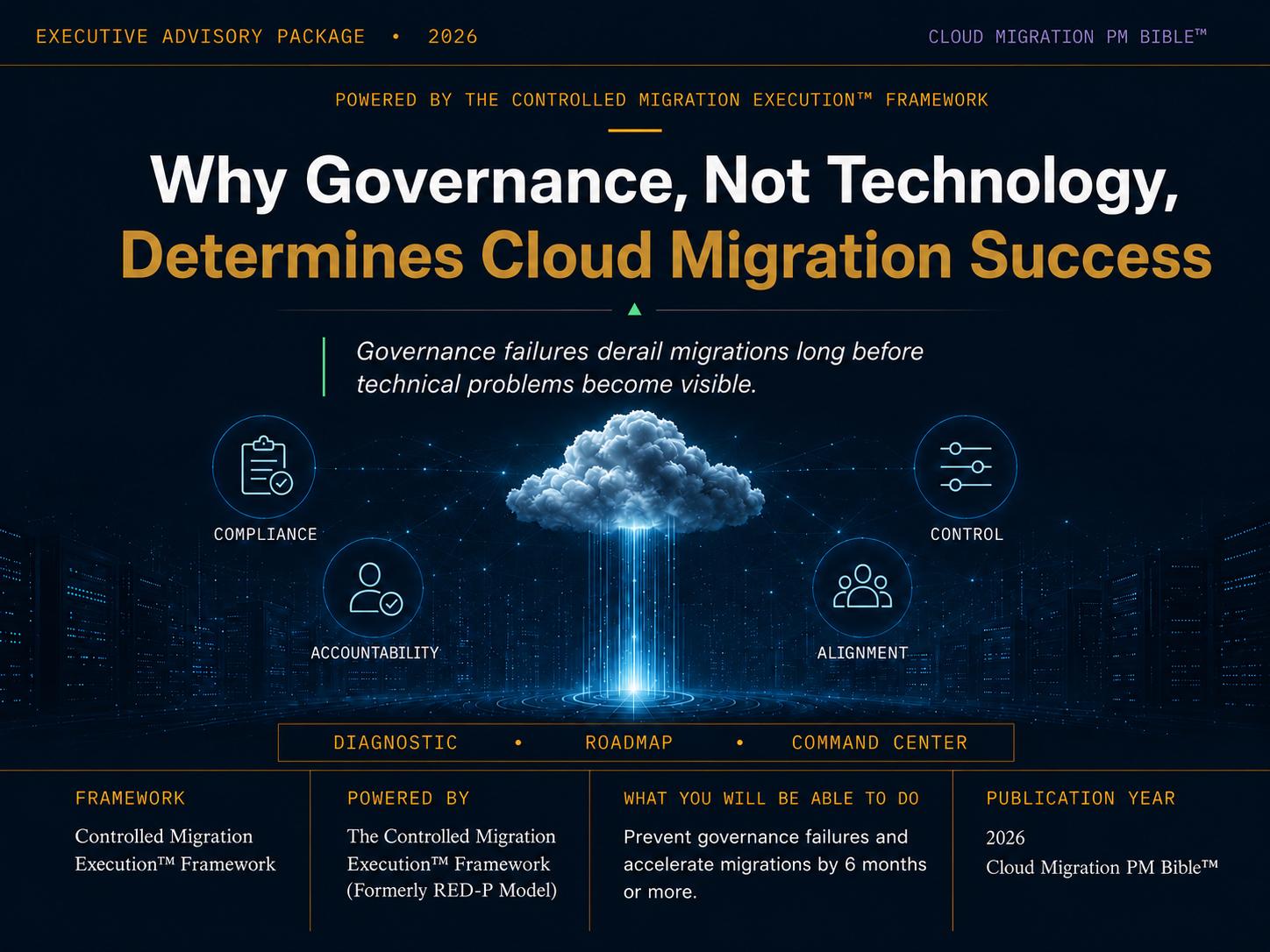
What You Will Be Able To Do: Score your organization's AI infrastructure governance readiness across 12 evidence-based checkpoints — and know exactly where to intervene first.
The AI infrastructure backlash is accelerating. Community opposition to data centers, utility rate disputes, water and cooling constraints, and AI workload continuity failures are no longer hypothetical risks discussed in strategy decks — they are live operational exposures that surface in public, on short notice, with no warning period.
Most organizations responding to this pressure default to activity: hire a consultant, write a policy, schedule a town hall. Few ask the harder diagnostic question first — what, specifically, do we have evidence for, and what are we simply assuming?
The AI Infrastructure Diagnostic Cards™ exist to answer that question directly. Drawn from the RED-P Organizational Diagnostic & Execution Model in the Cloud Migration PM Bible™, the instrument translates four governance lenses — Role, Environment, Development, and Priority — into 12 short-form cards, each built around a single accountability question and five evidence checkpoints.
1 — Why Evidence, Not Assumption
The diagnostic discipline behind these cards is simple but unforgiving: every checkpoint is marked Evidenced, Partial, or Unknown. There is no checkbox for "probably fine."
This matters because most AI infrastructure governance failures are not failures of intent. Organizations generally believe they have community relationships, utility agreements, and continuity plans in reasonable shape. The diagnostic forces a harder test — not whether the organization believes it has a plan, but whether that plan is named, documented, owned, and tested.
An unnamed owner is not a governance structure. An undocumented agreement is not a transparency posture. An improvised runbook is not a continuity plan. The cards are built to surface exactly that gap between belief and evidence.
2 — Lens One: Role — Who Owns This?
The Role lens asks a single question across four risk domains: if this became a public crisis tonight, who is accountable, and do they know it?
- Card R-1 (Community Impact Governance): Is there a single named owner for community impact at each facility — not a committee — with the authority to pause a project and a direct line to executive leadership?
- Card R-2 (Utility Rate Dispute Ownership): Is the utility cost-sharing owner named in writing, with a documented escalation path and current visibility into agreements?
- Card R-3 (Noise Complaint Response): Is there a documented, enforced response protocol with a 24/7-reachable owner?
- Card R-4 (AI Workload Continuity Ownership): Is there a named AI Continuity Owner at the CIO or Architect level, with a tested plan and a real runbook — not an improvisation under pressure?
Committees do not own risk. Named individuals do. The Role lens exists to find out whether your organization has confused the two.
3 — Lens Two: Environment — Is the System Aligned?
The Environment lens shifts from individual ownership to systemic alignment — whether the organization is actively monitoring its surroundings or waiting to be surprised by them.
- Card E-1 (Community Sentiment Monitoring): Is sentiment tracked proactively, with public hearing calendars, local media, and resident complaints aggregated and briefed monthly — or will opposition be discovered only after it has already formed?
- Card E-2 (Utility Agreement Transparency): Are cost-sharing agreements documented, aligned to the March 2026 Ratepayer Protection Pledge, and explainable on demand?
- Card E-3 (Government & Regulator Communication): Are regulators briefed before community issues surface — not after?
- Card E-4 (Cross-Function Risk Alignment): Do engineering, legal, public affairs, and operations share one risk register and one governance cadence — or does leadership receive four separate, conflicting pictures?
A system that only learns about its own exposure after the exposure becomes public is not aligned. It is reactive by design.
4 — Lens Three: Development — Where Are the Capability Gaps?
The Development lens tests whether the organization has built the operational capability to back its governance intentions — water strategy, noise mitigation, continuity planning, and regulatory tracking.
- Card D-1 (Water & Cooling Capability): Is potable vs. reclaimed water use documented, with a drought-response plan for water-stressed regions?
- Card D-2 (Pre-Construction Noise Planning): Has a pre-construction acoustic study been completed, with barriers and setbacks defined before construction — not after the first complaint?
- Card D-3 (AI Workload Continuity Plan): Are multi-region routing paths and fallback inference providers defined and tested — and has a tabletop exercise for AI continuity ever actually been run?
- Card D-4 (State Legislation Readiness): Is there a state legislation tracker with an assigned owner, and an executive briefing package on regulatory exposure?
Capability gaps are forgivable when they're known. They become crises when they're discovered live, in public, during an incident.
5 — Lens Four: Priority — What Cannot Be Ignored Right Now?
The Priority card is used last, after Role, Environment, and Development are complete. Its function is sequencing, not scoring: of everything just diagnosed, what has to move first?
- Card P-1 (Executive Priority Triage): Which community opposition event is closest to becoming a public crisis? Which utility agreement is most exposed to ratepayer scrutiny? Which AI workload has zero continuity fallback? Which executive owns none of these risks — but should?
This is the card that turns a diagnostic into an action plan. Without it, organizations risk treating every gap as equally urgent — which in practice means treating none of them as urgent at all.
6 — What Your Score Means
Each of the 12 cards carries 5 evidence checkpoints — 60 total. Each item marked Evidenced is worth one point.
- 0–20 / 60 — Immediate Intervention. Critical governance gaps. Infrastructure, community, utility, and AI continuity risks are unmanaged. Escalation to a Level 01 RED-P Diagnostic is warranted immediately.
- 21–40 / 60 — Structural Gaps Present. Partial governance. Significant domains lack evidence-based controls. A Level 01 Diagnostic and a 90-day Safeguard Roadmap are recommended within 30 days.
- 41–60 / 60 — Foundation in Place. Governance controls exist but require validation and continuous monitoring. A Level 03 Command Center engagement is recommended to maintain execution discipline.
The Bottom Line
The organizations that get blindsided by AI infrastructure backlash are rarely the ones with zero governance. They are the ones with governance that exists in belief but not in evidence — a plan everyone assumes is solid because no one has been asked to prove it.
The diagnostic doesn't create the risk. It just removes the option to not know about it.
Work through the 12 cards with your leadership team, score honestly, and let the Priority card tell you where to act first — before a community opposition event, a utility dispute, or a continuity failure forces the sequencing decision for you.
Supporting Research:
- Cloud Migration PM Bible™ — AI Infrastructure Diagnostic Cards™, derived from the RED-P Organizational Diagnostic & Execution Model — Gérald L'Ouverture Noël, PMP® (2026)
- PMI Pulse of the Profession — Organizations with high PMO maturity complete 38% more projects on time and within budget.
- Gartner — Through 2027, 70% of digital transformations will fail due to inadequate governance architecture.
Framework: RED-P Organizational Diagnostic & Execution Model | Pillar: Frameworks | AI Infrastructure | June 2026
Source: Cloud Migration PM Bible™ · cloudmigrationpmplaybook.com
© 2026 Cloud Migration PM Bible™. All frameworks proprietary and reserved.