WK13: | Why Cloud Cost Optimization Fails Before It Starts

Cloud cost problems rarely begin with the bill. They begin with architectural decisions made before deployment. This article shows how to embed cost governance into migration strategy, architecture, ownership, and readiness—so unnecessary spending is prevented, not discovered.
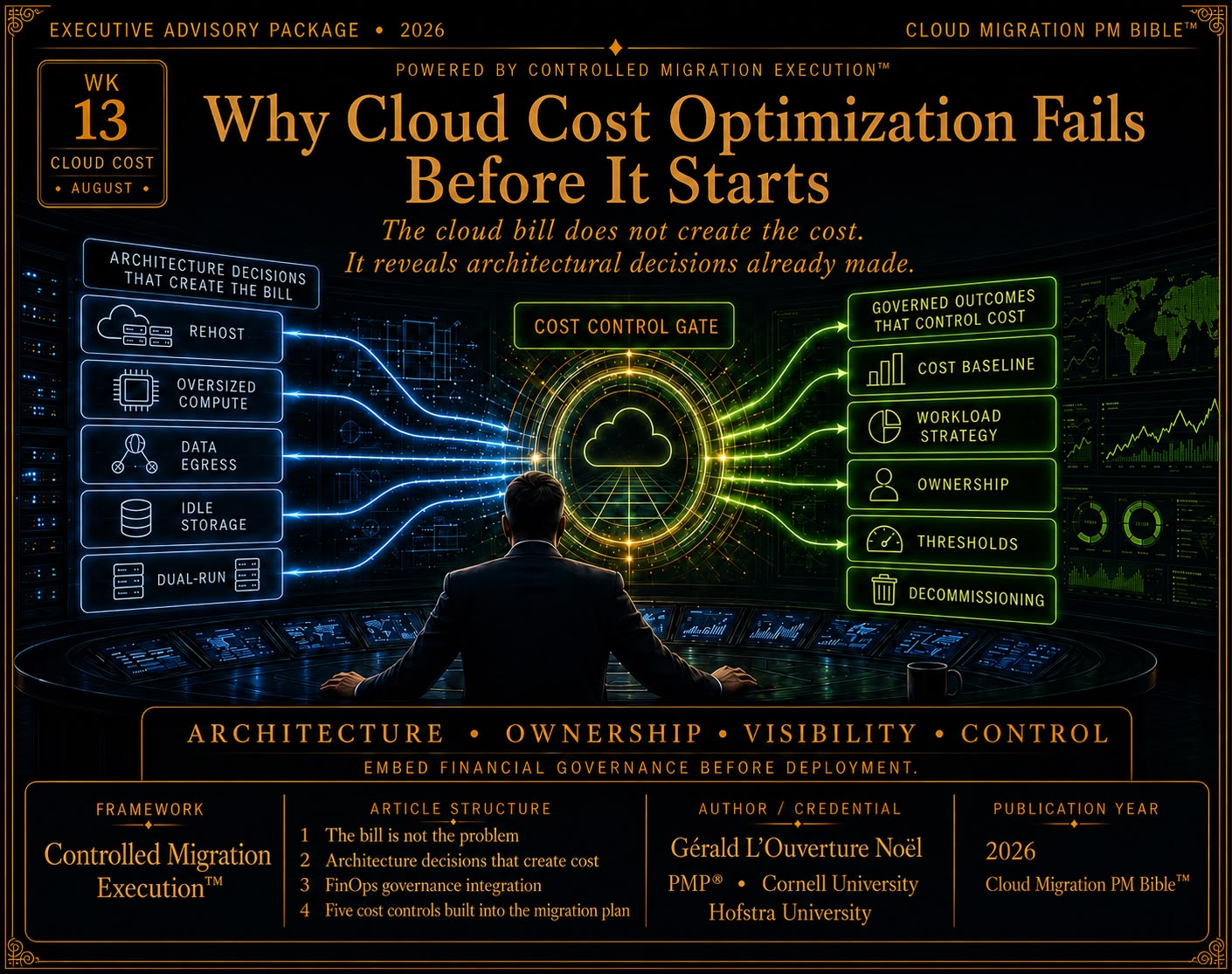

Why Cloud Cost Optimization Fails Before It Starts
Why the cloud bill is evidence of an earlier architectural decision — and how to embed financial control before deployment.
Most cloud cost problems are created in the architecture decision — not in the cloud bill. By the time the bill arrives, the governance failure has already happened.
Organizations often discover their cloud cost problem at the end of the month.
The bill arrives.
Leadership asks why spending exceeded the forecast. Finance begins comparing actuals against the business case. Engineering searches for oversized instances, idle storage, unattached resources, excessive data transfer, and forgotten development environments.
Then the organization launches a cost-optimization initiative.
But by that point, optimization has already started too late.
The cloud bill did not create the cost. It merely exposed decisions that were made weeks or months earlier — when workloads were assessed, migration strategies were selected, services were designed, capacity was estimated, and ownership was assigned.
Or, more accurately, when some of those decisions were never made at all.
Cloud cost optimization fails before it starts when financial governance is treated as a post-migration activity instead of an architectural control.
The bill is not the problem. It is the evidence.
The Problem: Moving Cost Without Changing Its Structure
Many cloud migrations begin with a financial promise:
Move to the cloud. Reduce infrastructure expense. Eliminate data-center costs. Pay only for what the organization uses.
But cloud does not automatically remove inefficiency. It changes how inefficiency is purchased.
On-premises waste is often hidden inside capital investments, fixed capacity, depreciation schedules, and hardware that has already been paid for. In the cloud, the same inefficiency becomes continuously measurable consumption.
An oversized server becomes an oversized virtual machine billed every hour. An inefficient application becomes persistent compute demand. Poor data architecture becomes storage growth, replication cost, backup cost, and data-transfer charges.
A forgotten test environment becomes a recurring monthly expense. A legacy dependency that prevents decommissioning becomes the cost of running two environments instead of one.
Nothing has necessarily become more expensive because it entered the cloud. The organization has simply made its architectural inefficiency visible — and recurring.
Cloud Migration PM Bible™ captures this failure directly: “The wrong strategy increases cost” and “The wrong strategy cannot be fixed by execution.”
The book presents a large-enterprise scenario in which engineering defaults to Rehost because the mandate is simply to “move everything to the cloud.” Months later, costs have increased, performance problems have emerged, and the legacy inefficiencies remain.
The result is not transformation. It is relocation.
Book foundation: Cloud Migration PM Bible™, Chapter 7, “Migration Strategy and the 6R Framework,” pp. 262–264.
1 | The Bill Is Not the Problem
A cloud invoice reports consumption after architectural and operational decisions have already taken effect.
It can show which services generated cost, which accounts or subscriptions consumed resources, how spending changed over time, and where unusual usage may have occurred.
But the invoice cannot explain why the architecture required that consumption.
It cannot tell leadership why an application was rehosted instead of replatformed. It cannot explain why a database was overprovisioned, why an environment must run continuously, why data crosses regions, or why the legacy platform remains active after migration.
Those answers exist upstream — in the migration strategy, workload design, dependency model, resilience requirements, and operating decisions.
This distinction matters because organizations frequently respond to high spending with billing-level actions: rightsize instances, buy reservations, delete idle storage, negotiate a discount, set another budget alert.
These actions may reduce waste, but they cannot fully correct an architecture that was never designed for cost efficiency.
You can discount an inefficient workload. It remains inefficient. You can monitor an oversized environment. It remains oversized. You can tag a poor architectural decision. It remains a poor architectural decision.
Cost optimization is strongest when it prevents unnecessary consumption — not when it negotiates a lower rate for consuming the wrong resources.
2 | Architecture Decisions That Create Cost
Every workload carries an economic design, whether the organization deliberately defines one or not. The migration strategy determines much of that design.
A Rehost decision preserves the application largely as it exists. That may be appropriate when speed is critical, such as during a data-center exit or urgent infrastructure refresh. But Rehost can also preserve hidden weaknesses, manual operating patterns, and inefficient cost structures.
Cloud Migration PM Bible™ is explicit: Rehost fails when it is treated as a long-term solution, when immediate cost optimization is expected, or when the legacy architecture is fundamentally broken.
Replatforming creates an opportunity for moderate improvement by moving to managed services, adjusting storage and scaling configurations, or improving operational supportability.
Refactoring can create deeper cost efficiency through cloud-native architecture, but it requires greater engineering maturity, more time, and a business case strong enough to justify the transformation.
Retiring a workload may produce the most immediate saving of all — because the least expensive resource is the one the organization no longer needs.
The cost problem, therefore, begins when one strategy is applied to every workload without examining actual utilization patterns, performance and availability requirements, storage growth and retention, data-transfer behavior, licensing implications, scaling requirements, dependency constraints, operational support costs, and decommissioning feasibility.
Architecture determines what the organization will consume. Consumption determines what the organization will pay. The invoice only completes the sequence.
Book foundation: Cloud Migration PM Bible™, Chapter 7, pp. 263–277; Rehost and Replatform guidance, pp. 271–273.
3 | FinOps Must Enter Before Deployment
FinOps is often introduced after cloud spending becomes visible. That is useful — but incomplete.
Financial governance must enter while the architecture is still being designed and while migration decisions can still be changed without expensive rework.
FinOps does not mean finance controls the architecture. It means architecture, engineering, finance, product ownership, and program leadership make cost consequences visible before approving the design.
The FinOps Foundation reinforces this principle in its guidance on architecting applications for cost efficiency: a significant share of lifecycle cost is shaped during architecture and design, so FinOps involvement should move upstream rather than rely only on post-deployment optimization.
Cloud cost is not merely an operational metric. It is an architectural requirement.
The migration team should therefore evaluate cost alongside security, performance, resilience, and availability — not after those decisions have already hardened into production.
This is where the Cloud Migration PM Bible™ becomes the hero framework. Its Migration Master Framework places discovery, analysis, planning, decision validation, architecture assessment, and technical validation before controlled execution. The sequence matters because a cost assumption is still reversible during planning. After deployment, it becomes operating expense.
The framework’s Decision Validation & Readiness Gate asks whether the plan is ready to be executed based on evidence — not confidence alone. For Week 13, that gate must include financial evidence.
Book foundation: Cloud Migration PM Bible™, Chapter 5, “The Dual-Phase Migration Model,” pp. 205–231; Decision Validation & Readiness Gate, pp. 218–220; Risk & Architecture Assessment, p. 221; controlled execution sequence, p. 224.
4 | Five Cost Controls to Build Into the Migration Plan
Control 1 — Establish the workload cost baseline
Before selecting a migration strategy, determine what the workload costs today and what business service that cost supports.
The baseline should include infrastructure, licenses, storage, network, support effort, backup, disaster recovery, and dependent systems.
Without a baseline, the organization cannot prove that migration improved the economic outcome. It can only compare one incomplete number with another.
Control 2 — Select the strategy per workload
Do not allow “cloud first” to become “Rehost everything.” Each workload must be evaluated independently against the 6R strategies. The decision should document why the workload will be rehosted, replatformed, refactored, repurchased, retained, or retired — and what cost behavior that choice is expected to produce.
Strategy is not a technical label. It is a long-term financial commitment disguised as a migration decision.
Control 3 — Design ownership and cost visibility into the architecture
Every cloud resource must be attributable to an application, environment, business owner, technical owner, and cost center. Tagging standards, account structures, subscription boundaries, and ownership metadata must be defined before provisioning begins.
If cost cannot be traced to an owner, it cannot be governed. Unallocated spending is not merely a reporting weakness. It is an accountability gap.
Control 4 — Define financial thresholds before the wave begins
A budget is not a control unless a response is attached to it. The migration plan should define forecasted cost by workload and wave, acceptable variance thresholds, unit-cost measures tied to business activity, anomaly triggers, escalation ownership, decision authority, and conditions requiring architectural review.
A budget alert that no one is required to act upon is only a notification.
Control 5 — Prove decommissioning and optimization readiness
Migration savings frequently depend on shutting something down. If the legacy environment remains active because dependencies were missed, data was not archived, users were not transitioned, or rollback windows were never closed, the organization begins paying for coexistence.
Parallel operation may be necessary during validation, but it must have a defined exit condition. A transition without an exit becomes permanent duplication.
The migration wave should not close until the organization can prove that obsolete infrastructure, licenses, interfaces, storage, and support obligations have been removed — or that an accountable exception has been approved.
The Controlled Migration Execution™ Cost Gate
Before authorizing deployment, leadership should be able to answer five questions with evidence:
1. What does this workload cost today?
2. Which migration strategy was selected, and why?
3. What architecture decisions will drive future consumption?
4. Who owns the cost, variance, and corrective action?
5. What will be retired after migration, and when?
If any answer depends on assumption, the workload is not financially ready to move. Pause the wave. Validate the design. Model the consumption. Clarify ownership. Then proceed.
This is Controlled Migration Execution™ applied to cloud economics: financial governance embedded into discovery, architecture, readiness, deployment, and closure — not added after the invoice exposes the gap.
The Bottom Line
Cloud cost optimization does not begin when finance reviews the bill. It begins when the organization decides what the workload should become.
The cloud bill is a delayed architectural signal. It reveals the consequences of migration strategies, capacity assumptions, data patterns, ownership decisions, and decommissioning failures that have already entered production.
By the time those costs appear, the organization may still reduce them — but the least expensive moment to govern them has passed.
The decisive question is therefore not: How do we reduce this month’s cloud bill?
It is: What must be true in the architecture and migration plan so this cost is never unnecessarily created?
Execution defines the truth: a cloud migration is not financially optimized because its bill is monitored. It is optimized when cost is designed, owned, measured, and controlled before deployment.
Source Alignment / Published Manuscript
The Week 13 article is grounded in the following sections of the published Cloud Migration PM Bible™ manuscript. Page ranges below were verified against the 576-page manuscript supplied for this edition.
Primary support
Cloud Migration PM Bible™ — Chapter 7, “Migration Strategy and the 6R Framework,” pp. 262–298.
• Strategy failure and increased cost, pp. 263–264
• 6R strategic decision model, pp. 265–270
• Rehost cost limitations, pp. 271–272
• Replatform and Refactor considerations, pp. 272–274
• Retire strategy and cost reduction, pp. 276–277
Framework foundation
Cloud Migration PM Bible™ — Chapter 5, “The Dual-Phase Migration Model,” pp. 205–231.
• Analysis & Planning, p. 216
• Decision Validation & Readiness Gate, pp. 218–220
• Risk & Architecture Assessment, p. 221
• From Validation to Controlled Execution, p. 224
Supporting external references
1. FinOps Foundation. Architecting VM-based Applications for Cost Efficiency. Published 2025. The guidance argues for proactive FinOps involvement during requirements and architecture, before post-deployment optimization, and explains how design decisions shape long-term operating cost.
2. FinOps Foundation. Architecting for Value. Current FinOps Framework guidance. It formalizes “shifting left”: embedding financial requirements, cost estimation, and value alignment before workloads reach production.
3. FinOps Foundation. Cost-Aware Product Decisions. October 16, 2024. Explains the move from cost as an operational afterthought to cost as a product and architecture design consideration.
Editorial alignment
The five Week 13 cost controls are an application of Controlled Migration Execution™ to cloud economics. They are not presented as verbatim controls from the book; they extend the manuscript’s validated sequence of discovery, strategy, readiness, architecture assessment, execution, stabilization, and optimization.
Additional manuscript verification
• Cloud Migration PM Bible™ — Chapter 6, “The Seven Phases of Migration Execution,” p. 260. Wave closure requires formal business sign-off, retirement of the rollback plan, and closure that is measured, verified, and approved. A migration is complete when risk is removed — not when systems move.
• Cloud Migration PM Bible™ — Chapter 15, “Applying the Migration System in Real-World Conditions,” pp. 468–469. The Cloud Platform Runbook requires tagging standards, cloud cost visibility, and tracking of cost behavior after go-live — the manuscript basis for Controls 3, 4, and 5.
Publication note: Cloud Migration PM Bible™ is the primary framework source for this Week 13 article. External FinOps references are used to corroborate the financial-governance and architecture-cost relationship. Cloud Migration PM Bible™ is available through Amazon, Barnes & Noble, and Books-A-Million.
© 2026 Cloud Migration PM Bible™ — a practice of Eclipse9 Solutions LLC. All rights reserved. www.cloudmigrationpmplaybook.com