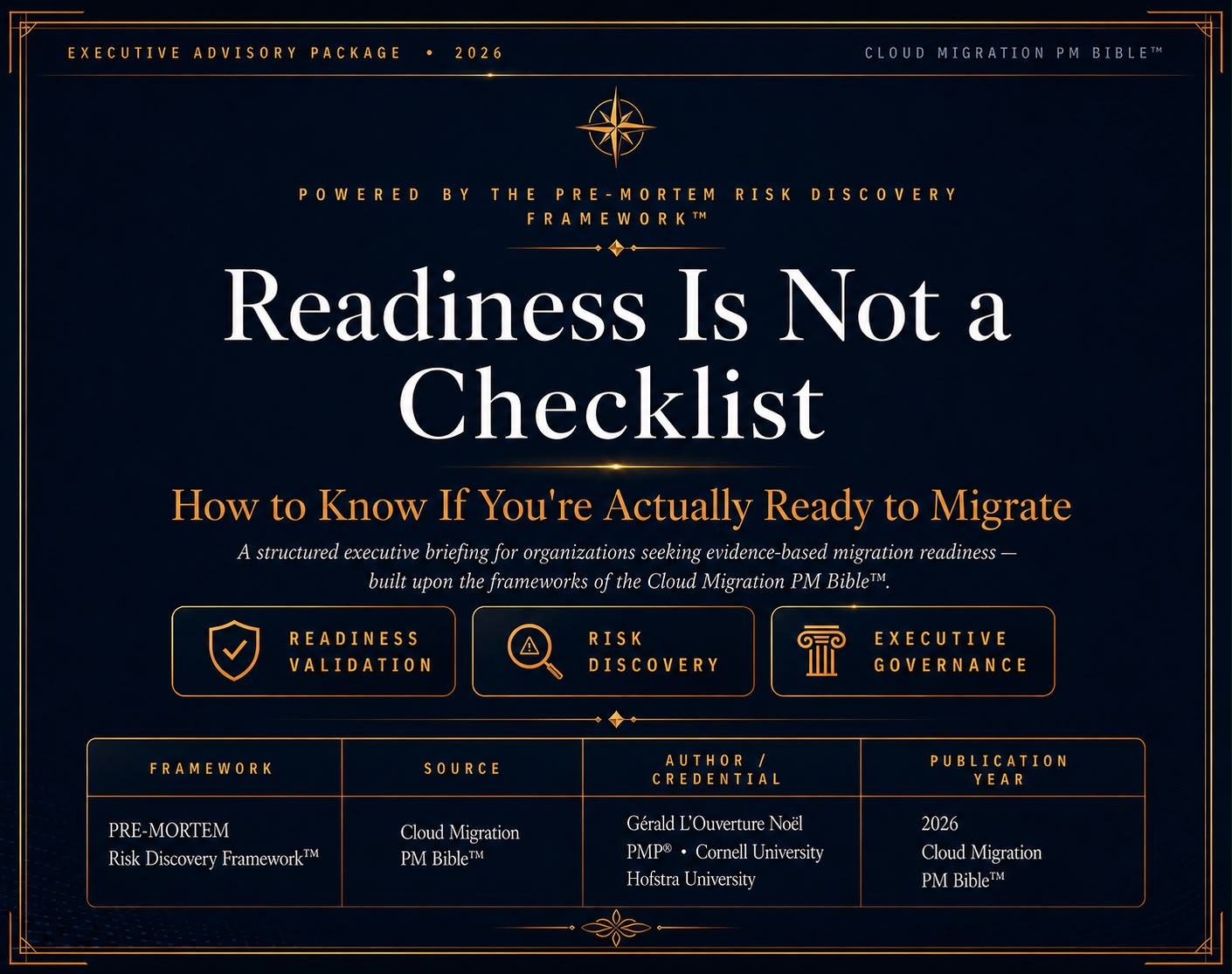
WK:4 | Readiness Is Not A Checklist: How to Know If You're Actually Ready to Migrate

Migration readiness is not proven by completed activities. It is proven by validated control. Most organizations believe they are ready because the checklist says they are. But a team can hold meetings, produce documents, update trackers, run workshops, complete assessments, and still not be ready. Readiness Proves Control. Activity Proves Effort.

The Most Critical Misconception in Enterprise Migration
Why organizations mistake artifacts for assurance — and the cost of that mistake.
What You Will Be Able To Do: Validate readiness through control mechanisms rather than checklists. Move from activity-based assessment to evidence-based validation.
1 — The Problem: Why Readiness Checks Fail
Migration failures rarely begin during cutover. They begin weeks or months earlier, when hidden risks were left unchallenged.
Research from Gartner (2023) found that 70% of digital transformation initiatives fail to achieve their intended outcomes. Of the primary failure drivers, readiness assessment and validation deficiencies rank among the top three.
The core problem is not visibility. It is verification.
Organizations often mistake artifacts for assurance. But an artifact only becomes valuable when it isconnected to execution and validated through real conditions.
McKinsey & Company researchfound that coordination failures and delayed decision-making account for upto 50% of enterprise program cost overruns. Poor readiness assessment is directly correlated with these failures.
A team can hold meetings, produce documents, update trackers, run workshops, complete assessments, and still not be ready.
The checklist does not reveal control. It only reveals completion.
2 — Why PRE-MORTEM Risk Discovery Framework™ Is the Right Tool
The PRE-MORTEM Risk Discovery Framework™ was built to identify the system beneath the surface of any failing initiative. Not just the symptoms. The root architecture of breakdown.
Originally applied to enterprise migration environments, PRE-MORTEM was designed around a core truth: projects do not fail because we lack understanding — they fail because we misjudge urgency.
The framework extends the original pre-mortem concept (introduced by Gary Klein) into a formal, repeatable methodology integrated with enterprise execution. It moves pre-mortem thinking from discussion to governance mechanism, and from exercise to execution driver.
The difference is critical. A discussion remains insight. A governance mechanism becomes control.
3 — The P.R.E.M.O.T. Model™: Six Operational Steps
The P.R.E.M.O.T. Model™ turns failure-first thinking into structured execution discipline. It forces risks to be predicted, revealed, evaluated, mitigated, ordered, treated, and tracked.
P — PROJECT FAILURE SIMULATION
Begin by imagining the migration has already failed. What happened? Why did it fail? This reframing disrupts optimism bias and surfaces the real vulnerability architecture.
R — RISK BRAIN DUMP
Each participant independently documents causes of failure. Conducted silently to eliminate group think and surface unspoken risks that formal processes leave hidden.
E — EXPOSE & SHARE
Shared in round-robin format with strict rules: No interruption, filtering, judgment, or debate. All inputs captured centrally. Every voice must be heard exactly as spoken.
M — MAP & CLUSTER
Grouped into six domains:
• Technical — Architecture, infrastructure, integration, performance
• Operational — Process, handoff, escalation, runbook execution
• Organizational — Staffing, capability, decision authority, communication
• Vendor — Dependencies, SLAs, support, contract compliance
• Compliance — Regulatory, audit, control, policy persistence
• External — Market, partner, customer, third-party impact
Transforms raw input into structured insight.
O — ORDER & PRIORITIZE
Risks prioritized using Likelihood × Impact, MoSCoW, or RED Lens filtering. Ensures attention to what truly threatens execution.
T — TREAT & TRACK
Converted into executionartifacts integrated into RAID logs, schedules, governance reports, and cutover runbooks.
Without this step, the pre-mortem remains insight. With this step, it becomes control.

Without this step, the pre-mortem remains insight. With this step, it becomes control.
4 — Five Readiness Signals Leaders Must Validate
Before approving go-live, leaders should ask for readiness signals — not just status updates.
01 | DEPENDENCY READINESS
Every critical dependency must be known, validated, and owned. A dependency is ready when its behavior has been validated in the target migration path. Not assumed. Not hoped. Validated.
02 | ROLLBACK READINESS
Rollback cannot be theoretical. It must define:
• Triggers that activate it
• Decision authority that approves it
• Timing for execution
• Ownership and accountability
• Technical steps and sequencing
• Business impact and continuity assumptions
• Communication protocols
• Recovery validation procedures
If you cannot articulate every element, you are not ready.
03 | OPERATIONAL READINESS
The target state must be supportable: support, infrastructure, application, security, and business teams must understand how the new environment will operate. Not eventually. Before cutover.
04 | MONITORING AND INCIDENT READINESS
Monitoring must detect failure early. Leaders must know:
• What is monitored
• Who watches the alerts
• What conditions trigger escalation
• How incidents are communicated
• Who has authority to act under pressure
05 | DECISION READINESS
Decision authority must be clear. The organization must know:
• Who can pause execution
• Who can approve rollback
• Who can accept defined risks
• Who escalates when conditions change
• Who communicates impact
• Who authorizes continuation
Without decision readiness, execution becomes reactive rather than controlled.
5 — Executive Insight
The PMI Pulse of the Profession research found that organizations with clear governance frameworks and decision readiness structures complete 38% more projects on time and within budget.
That is not a statistic. That is the difference between control and chaos.
Organizations often assume readiness is a binary state—either you are or you are not. This is incorrect. Readiness is a system of validated controls. It is demonstrable evidence that the organization has thought through failure, identified the architecture beneath that failure, and created ownership for when reality diverges from the plan.
Readiness is not a checklist. It is validated evidence. It is disciplined execution. It is controlled migration.
6 — Three Questions Every Leader Should Ask
1. Can we articulate exactly what is being validated, and by whom?
If the answer is "the status report shows green," you do not have readiness validation. You have completion tracking.
2. Do we have decision authority established before execution begins?
If decisions will be made during the crisis, you are not ready. Readiness means authority exists before urgency arrives.
3. Have we imagined failure specifically enough to own it?
If the answer is "we have contingency plans," you have templates. PRE-MORTEM discipline requires that you have imagined specific failure, root-caused it, and assigned ownership for prevention.
7 — The Bottom Line
Most organizations spend millions designing architecture. Very few spend equal effort designing validation discipline.
Architecture determines whatis possible. Readiness validation determines what is permissible.
Because in enterprise transformation, execution does not fail at the point of movement. It fails at the point of validation—when the organization chose to proceed without evidence of control.
Don't migrate on the checklist. Migrate on the evidence.
Supporting Research & Citations
• Gartner, Digital Transformations Fail: Here's Why (2023) — 70% failure rate; readiness assessment deficiency identified as top three failure driver.
• McKinsey & Company, Why Do Digital Transformations Fail? (2022) — Coordination failures and readiness deficiencies account for up to 50% of cost overruns.
• Gary Klein, Performing a Project Pre-Mortem — Harvard Business Review (2007) — Original pre-mortem research and methodology.
• Daniel Kahneman, Thinking, Fast and Slow (2011)— Prospective hindsight and optimism bias research.
• PMI Pulse of the Profession (2023) — 38% project success improvement with governance and decision readiness structures.
• Cloud Migration PM Bible™ — Gérald L'OuvertureNoël, PMP® (2026)
Framework:PRE-MORTEM Risk Discovery Framework™ | Pillar: Readiness Validation | Week 4 |June 2026
Source:Cloud Migration PM Bible™ · cloudmigrationpmplaybook.com
© 2026 CloudMigration PM Bible™. All frameworks proprietary and reserved.