WK7: | Stakeholder Alignment is Not Agreement: It is Shared Accountability

Every migration leader believes the room is aligned. Few have proven that alignment survives once pressure arrives and someone must finally say no. Stakeholder alignment is not agreement — it is shared accountability. Most leaders confuse consensus in the kickoff with commitment under load, but alignment only becomes real when every obligation has a named owner, decision rights are defined before the room gets tense, and the consequence of non-action is documented instead of discovered. The Execution Command Center™ moves stakeholder alignment from sentiment to architecture, from agreement in the room to accountability in the system.


Agreement Is What People Say in the Room. Alignment Is What Accountability Survives When the Room Is Under Pressure.
The Most Dangerous Meeting in Enterprise Transformation
Why organizations mistake unanimous agreement for alignment — and the cost of that mistake.
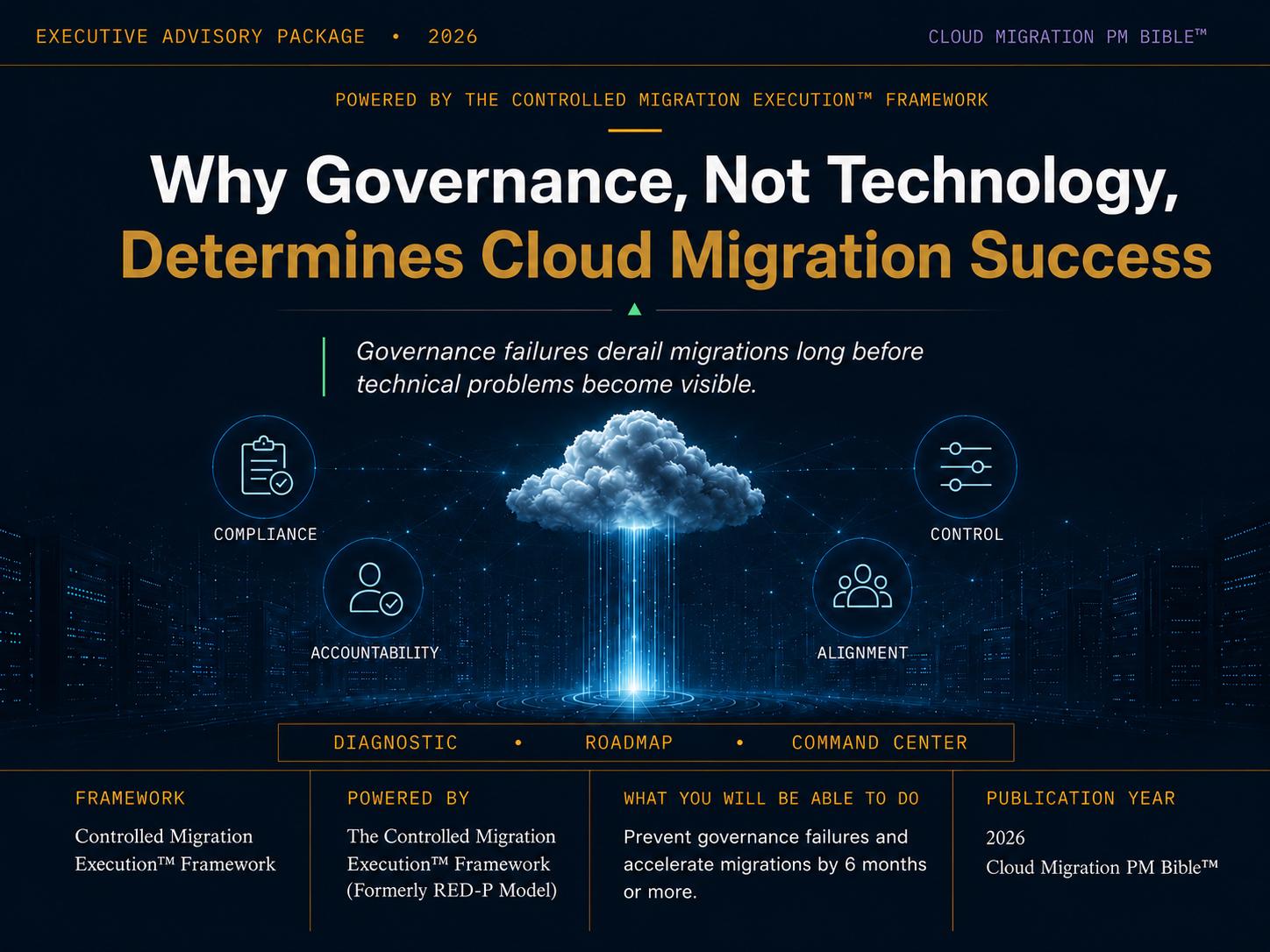
What You Will Be Able To Do: Evaluate stakeholder alignment through named ownership and tested accountability rather than consensus alone. Move from agreement-based assurance to accountability-based governance.
1 — The Problem: Why Consensus Collapses When Execution Demands Ownership
The most dangerous meeting in an enterprise transformation is not always the one filled with conflict. Sometimes, it is the one where everyone agrees. The infrastructure lead agrees. The application owner agrees. Security agrees. The business agrees. The executive sponsor agrees. The meeting ends on time. The presentation is green. The minutes say aligned.
Then pressure arrives. A dependency fails. Security raises a concern. The application team says the infrastructure was not ready. Infrastructure says the requirements changed. The business says it was never informed. Leadership asks why the risk was not escalated. Suddenly, the alignment disappears — because it never existed. What existed was agreement without accountability: a temporary social contract in which everyone accepted the language of the plan without accepting the burden of ownership. That is the alignment illusion.
In complex enterprise programs, the illusion survives for months because meetings create the appearance of coordination, status reports create the appearance of visibility, and consensus creates the appearance of commitment. But appearance is not control.

Research into employee voice puts the stakes in perspective. Detert and Edmondson’s Harvard Business School research, synthesized in Amy Edmondson’s The Fearless Organization (2018), found that 85% of employees report having withheld important information from their manager at least once for fear of the consequences of speaking up — the raw material of silence interpreted as consent.
Three alignment failures show up again and again in programs that lead with agreement instead of accountability:
• Silence is interpreted as consent. No one challenged the slide, so the organization records commitment — when what actually occurred was fear, fatigue, or strategic self-protection.
• Alignment becomes transactional — negotiated silence. “I will not challenge your deadline if you do not challenge my readiness. I will accept your green status if you accept mine.”
• Accountability remains ambiguous while milestones are marked complete. The organization is moving while its weakest ownership gaps remain hidden.

2 — Why the Execution Command Center™ Is the Right Diagnostic

The diagnostic foundation for Week 7 is not another consensus-building model. It is the Execution Command Center™, because the deeper failure is not poor communication — it is that organizations confuse communication with alignment and agreement with accountability. The framework tests whether stakeholder obligations remain visible and enforceable under pressure, not whether stakeholders felt aligned in the kickoff.
Pressure is the most effective diagnostic an organization possesses. Pressure does not destroy alignment; it reveals whether alignment existed in the first place. The Command Center makes that revelation happen before cutover instead of during it — by forcing named ownership, defined decision rights, evidence obligations, and controlled communication into the open.
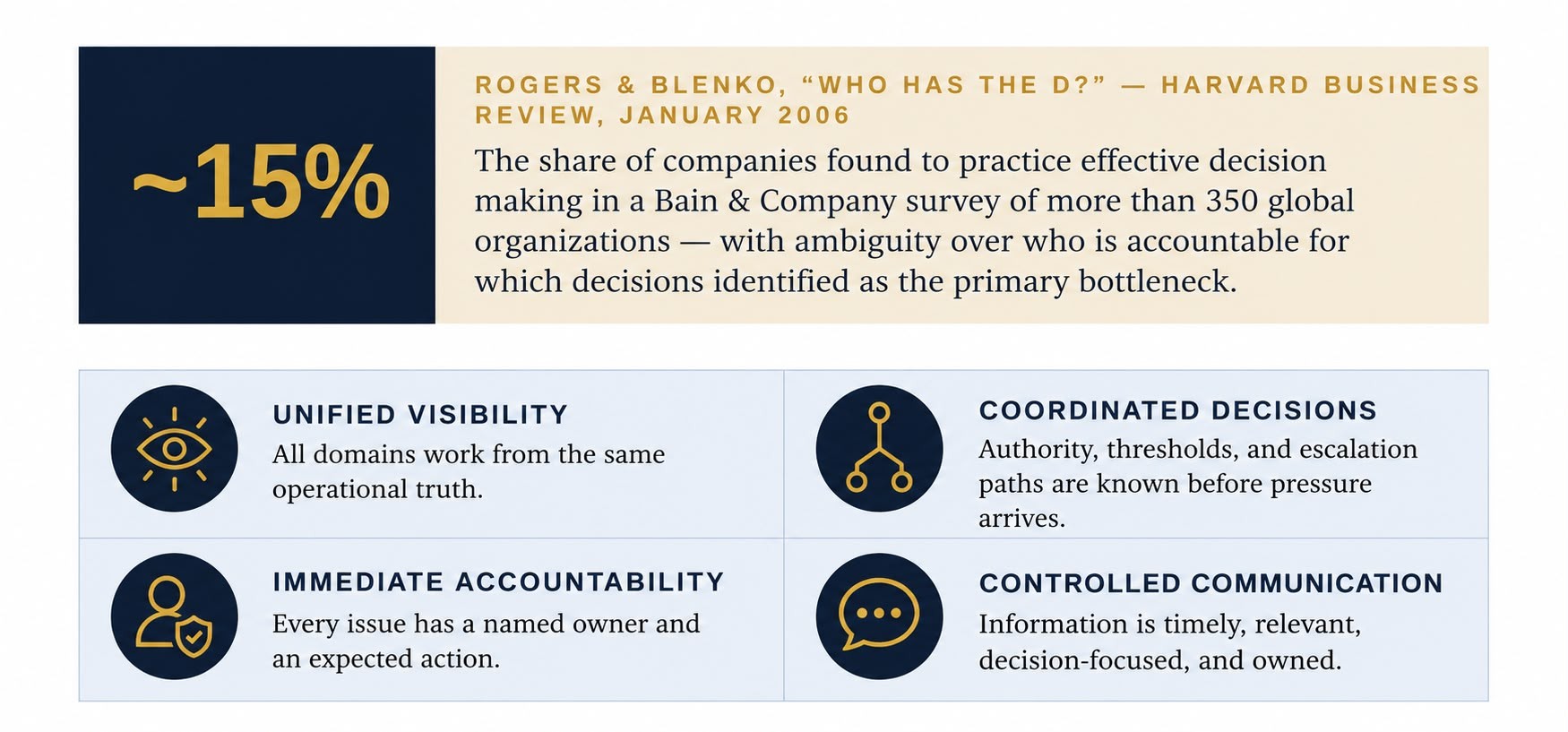
Decision-rights research reinforces why this discipline matters. Rogers and Blenko’s “Who Has the D?” (Harvard Business Review, January 2006), drawing on a Bain & Company survey of more than 350 global organizations, found that only about 15% of companies practice effective decision making — with ambiguity over who is accountable for which decisions identified as the primary bottleneck.
The Command Center tests four conditions before pressure arrives:
• Unified visibility. All domains work from the same operational truth.
• Coordinated decisions. Authority, thresholds, and escalation paths are known before pressure arrives.
• Immediate accountability. Every issue has a named owner and an expected action.
• Controlled communication. Information is timely, relevant, decision-focused, and owned.
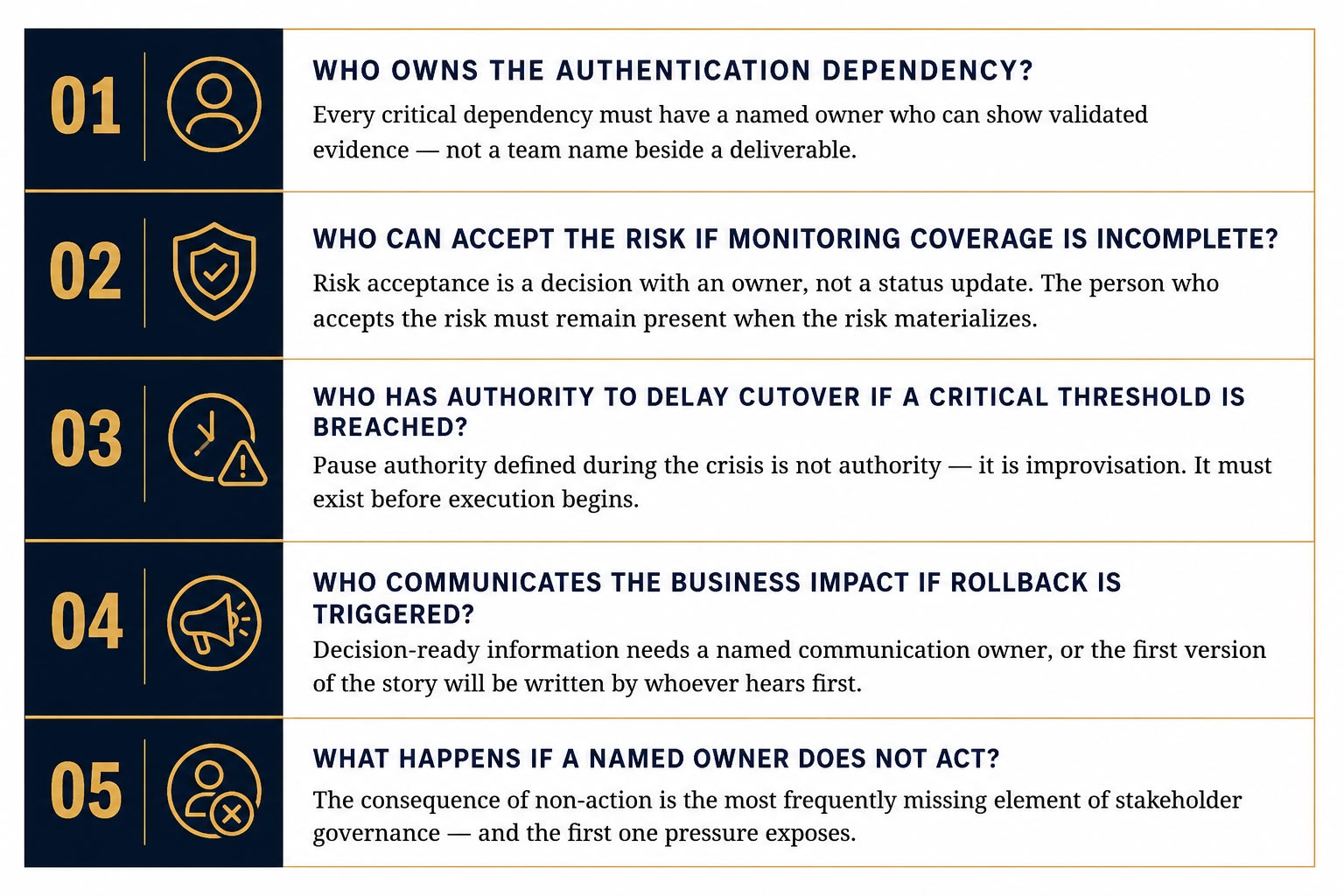
Diagnostic questions before execution: Who owns each critical dependency? Who can accept residual risk? Who has authority to pause execution? Who communicates business impact if rollback is triggered? What happens if a named owner does not act?
It is not a war room. It is leadership made visible.
3 — The Framework: Shared Accountability, Not Shared Agreement

Shared agreement says, “We support the decision.” Shared accountability says, “We understand our obligation to make the decision succeed.” Five stakeholders can agree to migrate an application on Saturday night — but agreement alone does not establish who validates infrastructure readiness, who confirms dependencies, who owns identity continuity, who accepts security risk, who represents business impact, who can pause execution, or who communicates a change in status. Without those answers, the organization has consensus but no control.
Shared accountability does not mean responsibility becomes collective and anonymous. Infrastructure owns infrastructure readiness. Security owns security validation. The application team owns application behavior. Operations owns support preparedness. The business owns impact acceptance. Program leadership owns coordination of the whole. These responsibilities converge — but they do not disappear into a collective fog. When everyone is accountable for everything, no one is accountable for anything.

One form of alignment is announced. The other is designed. One lives in meeting minutes. The other survives contact with reality. Real shared accountability preserves individual ownership while connecting every owner to a common outcome through one execution system.
Without design, alignment remains sentiment. With design, it becomes architecture.
4 — The Six Accountability Controls™: Mapped Before Execution Begins
If alignment is to become more than a slogan, accountability must be mapped for every critical decision, dependency, risk, and execution domain before execution begins — not assumed, implied, or left to titles. Organizations frequently document responsibility but fail to document the consequence of non-action. A name appears in a RACI matrix; the governance model remains silent about what happens when approval is late, evidence is incomplete, two stakeholders disagree, or a critical owner is unavailable.


5 — Governance Checkpoints: A Date Is Not Alignment

Consider a migration program in which all parties agree to a go-live date. Infrastructure says ready. Applications say ready. Security says ready. The business says ready. That sounds like alignment — until the leader asks different questions. If these questions produce silence, debate, or uncertainty, the organization was never aligned. It merely agreed on a date.

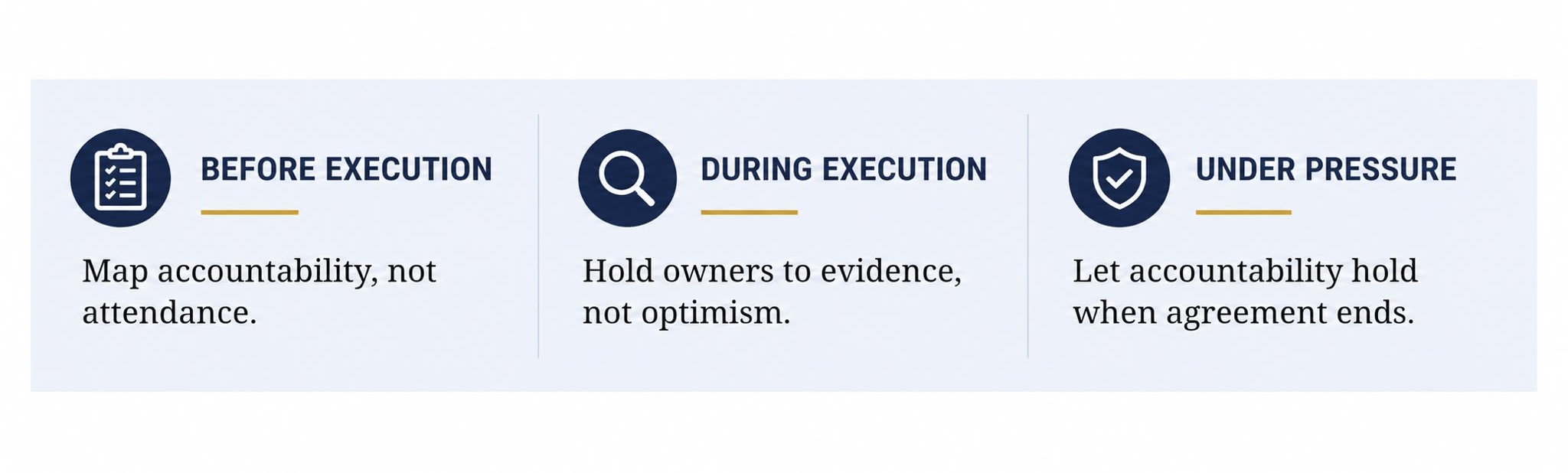
6 — Three Leadership Behaviors That Protect Alignment
Named ownership, decision rights, and productive disagreement all matter, but under pressure they compress into three disciplines that actually protect alignment when agreement runs out.

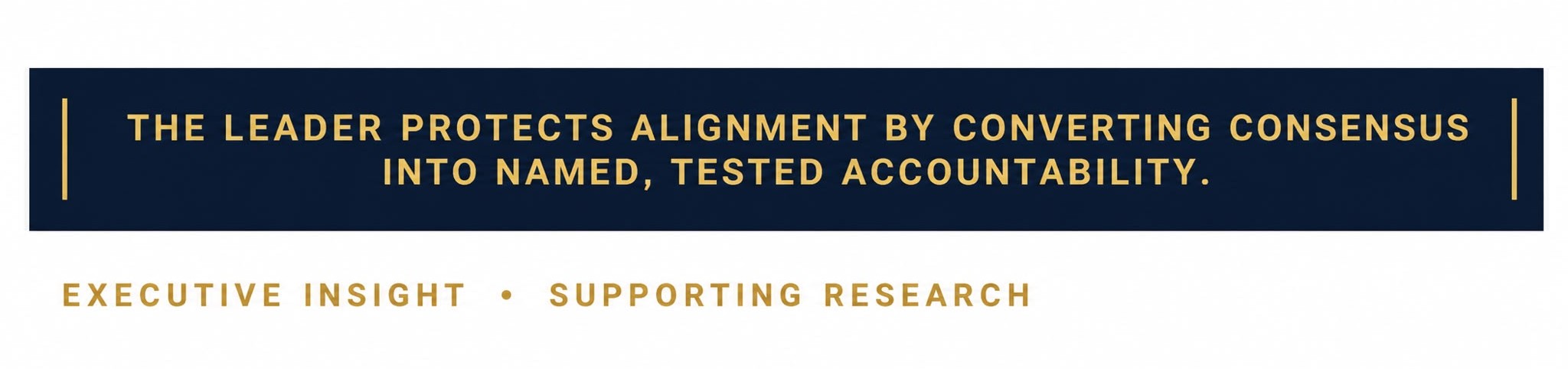
7 — Executive Insight: Consensus Is Rarely the Scarce Resource
Research outside the migration world confirms the same pattern. Bain & Company’s survey of more than 350 global organizations found that only about 15% practice effective decision making, and identified ambiguity over who is accountable for which decisions as the recurring bottleneck — the organizational condition this article calls the alignment illusion.
Rogers and Blenko’s prescription in Harvard Business Review is structurally identical to accountability mapping: assign a single decider, limit who must agree, and define every role before the decision is needed. Their central rule: for every important decision there must be exactly one person who holds the “D” — final authority to commit the organization. Consensus roles provide input; they do not decide.
Harvard Business School research by Detert and Edmondson explains why apparent agreement is so unreliable: 85% of employees report having with held important information from a manager out of fear of the consequences. Edmondson’s broader work on psychological safety shows that low-safety environments produce a culture of silence in which warnings go unheeded —precisely the negotiated silence that makes a green dashboard look like alignment.

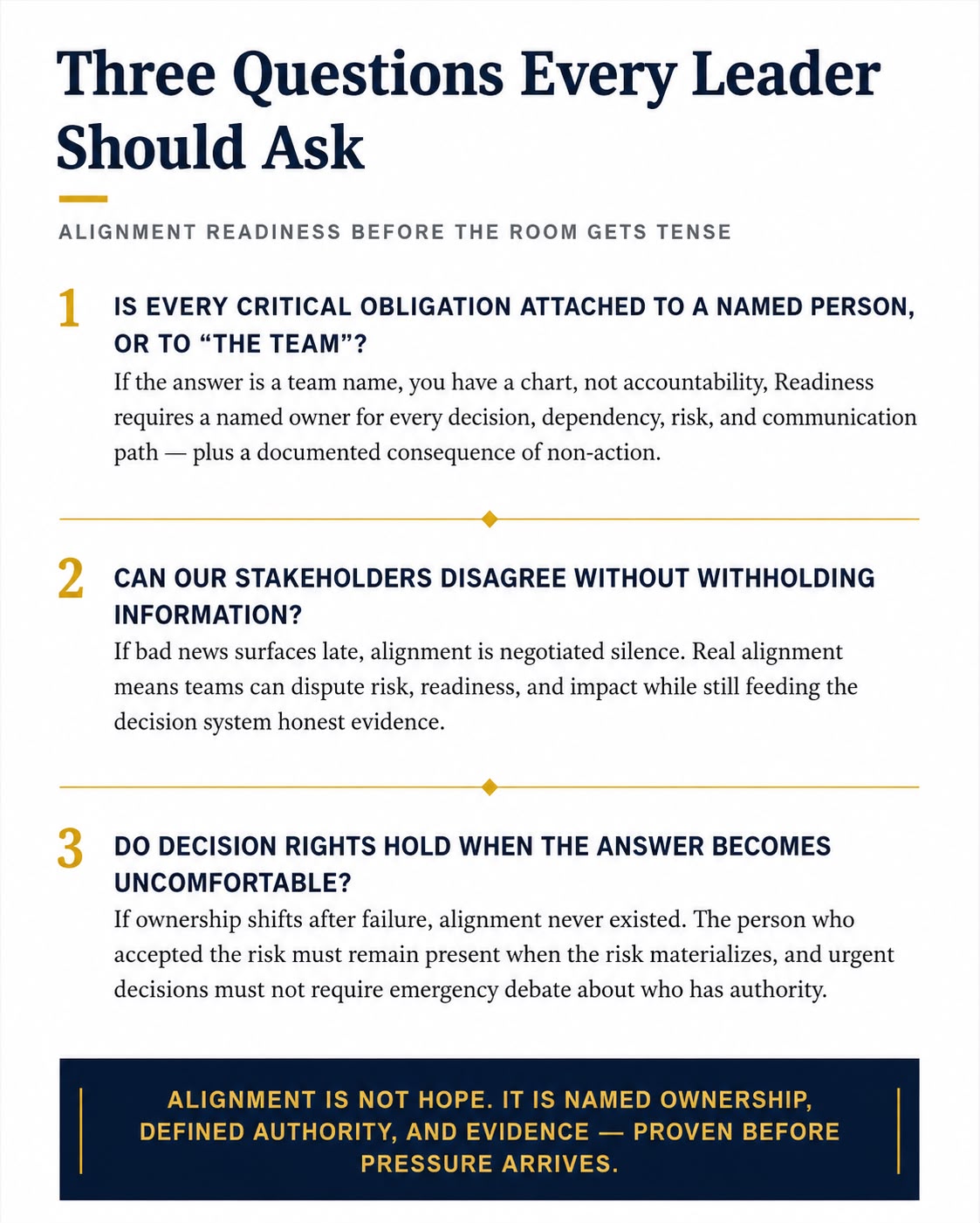
8 — Three Questions Every Leader Should Ask
9 — The Stakeholder Alignment Control Test™: Seven Tests of Real Alignment
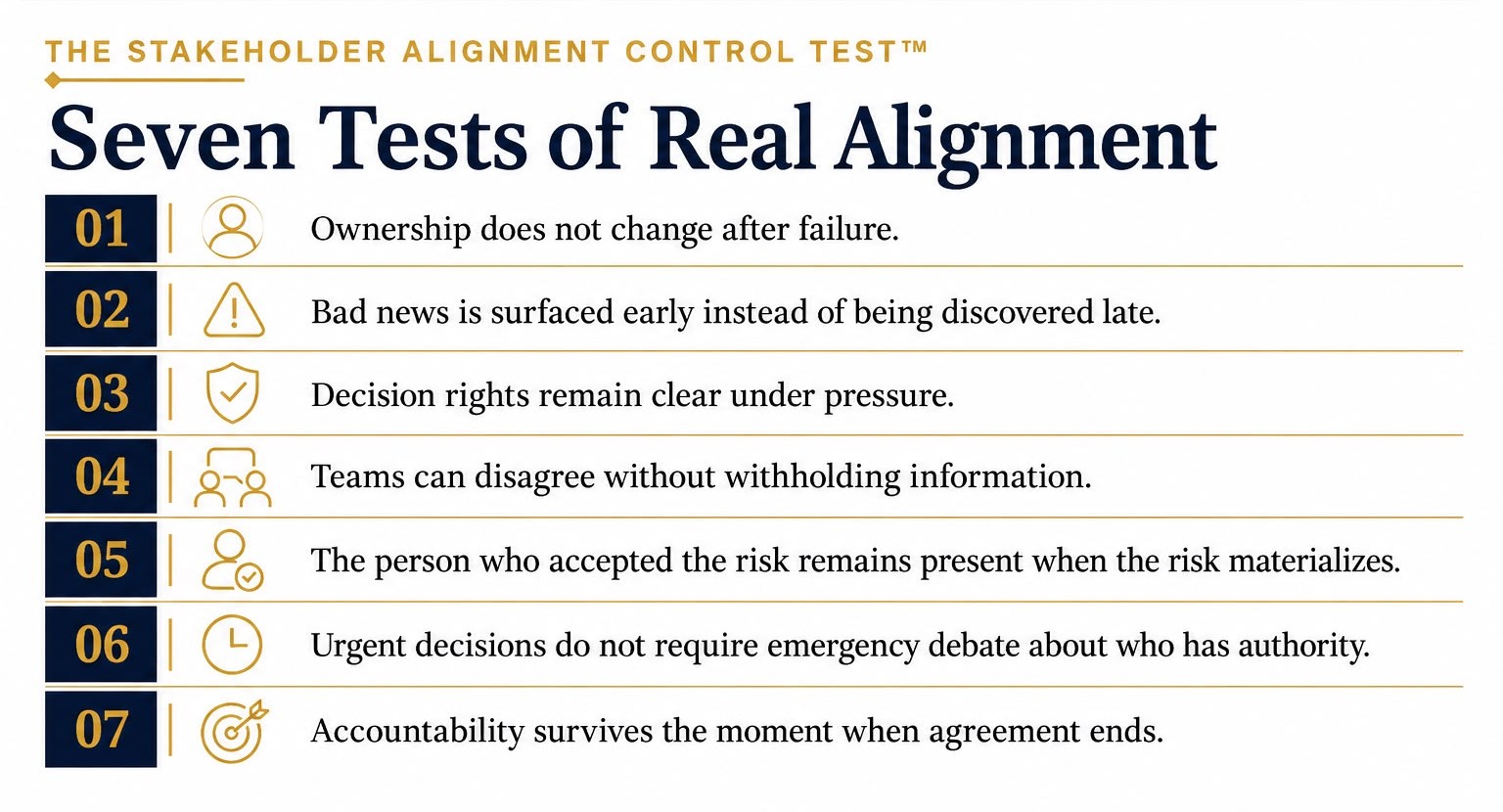


Organizations often assume alignment is a binary state — either the stakeholders are aligned or they are not. This is incorrect. Alignment is a system of tested controls: demonstrable evidence that the organization has named owners, defined decision rights, established evidence obligations, set escalation thresholds, assigned communication ownership, and documented failure consequences before pressure arrives.
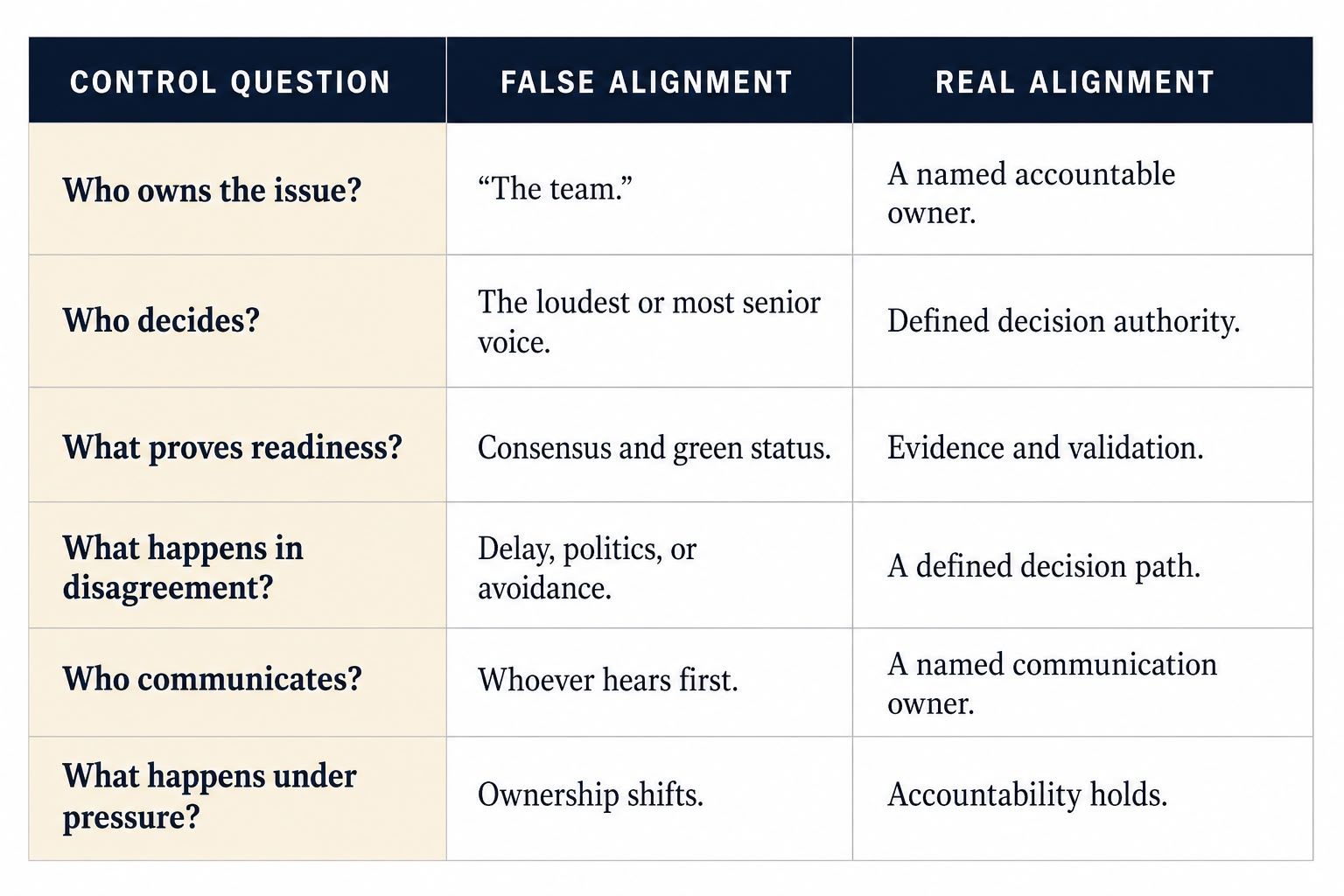
10 — The Bottom Line
A successful meeting cannot prove alignment. A signed document cannot prove alignment. A green dashboard cannot prove alignment. Even unanimous agreement cannot prove alignment. Pressure does.

The most dangerous form of misalignment is not open conflict. Open conflict is visible; it can be discussed, governed, escalated, and resolved. The more dangerous condition is false alignment — the quiet organizational illusion in which everyone appears to agree because no one has yet been forced to prove what they own.
When a dependency fails, when a deadline tightens, when the evidence changes, when business impact becomes real, and when someone must make the unpopular decision — that is when the truth appears. The question is no longer “Do we agree?” It becomes: Who owns this? Who decides? Who acts? Who communicates? And who remains accountable when the answer becomes uncomfortable? The Execution Command Center™ exists to make those answers visible before pressure arrives.

External Resources — Week 7
• Paul Rogers & Marcia Blenko, “Who Has the D? How Clear Decision Roles Enhance Organizational Performance,” Harvard Business Review, January 2006, pp. 53–61 — Bain & Company survey of 350+ global organizations: only about 15% practice effective decision making; decisions stall because of ambiguity over who is accountable; the RAPID® model assigns a single decision authority (“the D”) for every important decision.
• James R. Detert & Amy C. Edmondson, Harvard Business School research on employee voice and silence; synthesized in Amy C. Edmondson, The Fearless Organization: Creating Psychological Safety in the Workplace for Learning, Innovation, and Growth (Wiley, 2018) — 85% of employees report having withheld important information from their manager for fear of consequences; low psychological safety produces a culture of silence in which warnings go unheeded.
Related Frameworks — Prior Weeks
• PMI Pulse of the Profession (2023) — organizations with clear governance and decision-readiness structures show stronger project delivery performance (carried forward from WK6).
• Barry M. Staw, “Knee-Deep in the Big Muddy: A Study of Escalating Commitment to a Chosen Course of Action” (1976) — escalating commitment under invested effort (WK6).
Shared Framework Source
• Cloud Migration PM Bible™ — Gérald L’Ouverture Noël, PMP® (2026). Execution Command Center™, Stakeholder Alignment Control Test™, and Six Accountability Controls™ alignment.
Manuscript Alignment


Framework: Execution Command Center™ | Pillar: Stakeholder Alignment & Shared Accountability | Week 7 | July 2026
Source: Cloud Migration PM Bible™ · cloudmigrationpmplaybook.com
© 2026 Cloud Migration PM Bible™. All frameworks proprietary and reserved.