WK: 1 | Why Cloud Migrations Fail in Governance, Not Technology

Most cloud migrations don't fail because the platform was wrong. They fail because governance was never built as a system. This article identifies the architecture illusion and fragmented decision authority that cause migration failure — and introduces the Controlled Migration Execution™ framework as the fix.
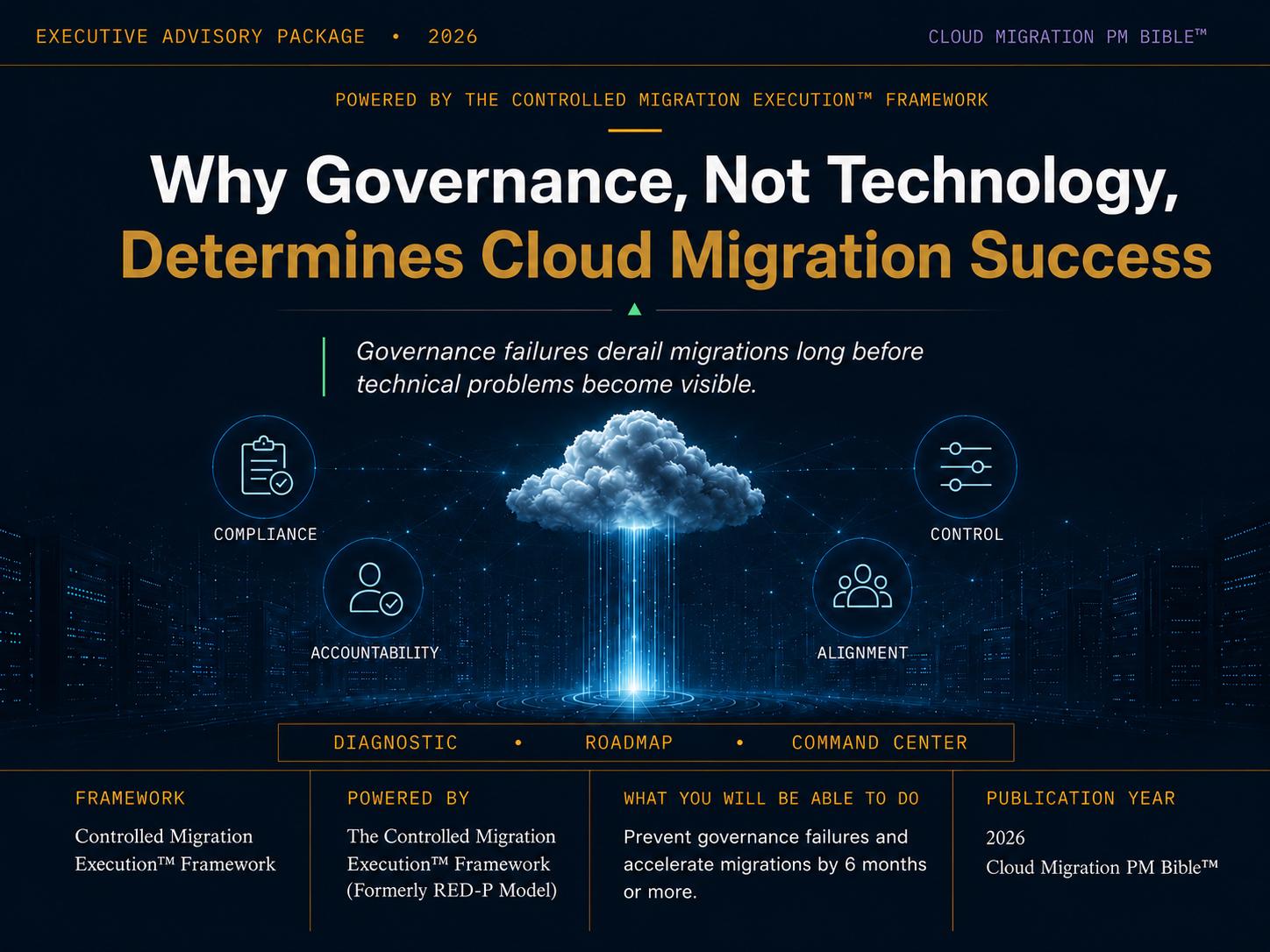

Why Cloud Migrations Fail in Governance, Not Technology
Most cloud migrations don't fail because the platform was wrong. They fail because governance was never built as a system.
What You Will Be Able To Do: Identify the governance gaps that cause migrations to fail before they become visible at cutover.
Every migration begins with a technology decision. Which cloud provider. Which architecture pattern. Which tools for orchestration, monitoring, and security. These decisions consume the majority of planning time, budget, and executive attention.
And yet, when migrations fail, the autopsy rarely points to the technology. It points to governance — or more precisely, to governance that was never designed as a coherent system in the first place.
1 — The Architecture Illusion
The architecture illusion is the belief that a well-designed technical architecture is sufficient to guarantee migration success.
It is a reasonable belief on the surface. Architecture diagrams are tangible. They can be reviewed, validated, and approved. They give executives something concrete to sign off on. Governance, by contrast, is abstract — it lives in meeting cadences, escalation paths, and decision rights that are harder to visualize and easier to underinvest in.
This creates a structural imbalance. Organizations spend months perfecting the technical design and weeks — sometimes days — defining how decisions will actually get made during execution.
The architecture tells you what the destination looks like. It says nothing about who decides when the journey goes off course.
When migrations fail, the failure is almost never "the cloud platform didn't work." It is "nobody could decide what to do when the plan needed to change." The architecture was sound. The governance to execute it was not.
2 — Fragmented Decision Authority
Fragmented decision authority is the condition where the people who can see a problem are not the people who can act on it, and the people who can act on it are not positioned to see the problem in time.
This fragmentation develops naturally in complex programs. The technical team identifies a dependency risk. They escalate it. The escalation reaches a steering committee that meets biweekly. By the time the committee convenes, the window to address the risk cheaply has closed. The decision is made — but it is made too late, under more pressure, with fewer options.
Fragmentation also occurs horizontally. The infrastructure team has authority over deployment sequencing. The security team has authority over control implementation. The business unit has authority over go-live timing. None of these groups has full authority over the outcome — yet the outcome depends on all three groups acting in coordination.
When authority is fragmented, every difficult decision becomes a negotiation. Negotiations take time. Migrations do not have time to spare at the moments that matter most.
3 — Controlled Migration Execution™
The corrective framework is Controlled Migration Execution™.
Controlled Migration Execution treats governance as infrastructure — something designed, built, and tested before it is needed, not assembled ad hoc when a crisis demands it.
The framework rests on four structural commitments:
- Decision rights are mapped before execution begins. Every category of decision — technical, security, business, vendor — has a named owner with defined authority and defined escalation conditions. This mapping happens during planning, not during the first crisis.
- Escalation has a response-time guarantee. A risk that requires executive input does not wait for the next scheduled meeting. Controlled Migration Execution builds escalation paths with committed response windows — hours, not weeks.
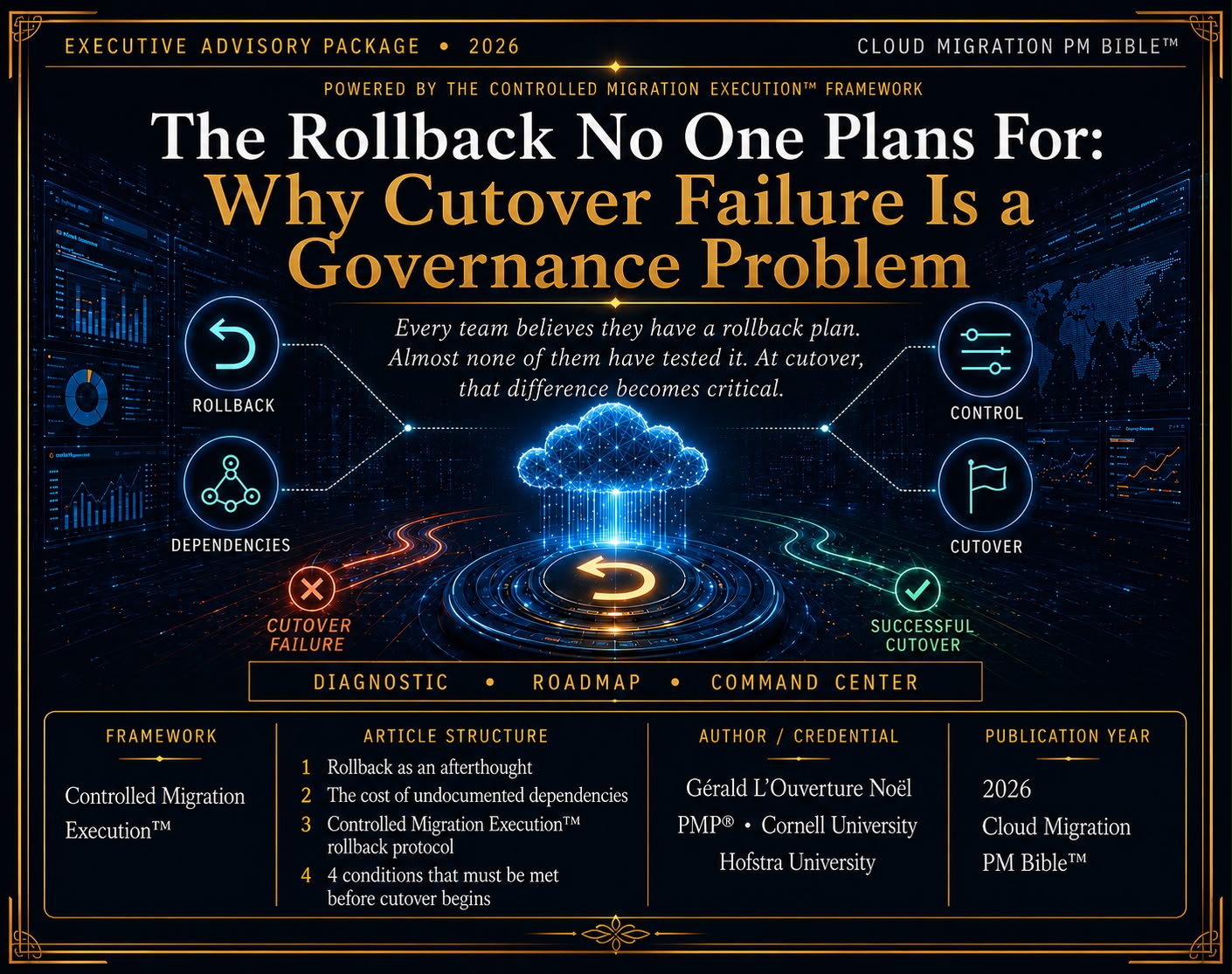
- Rollback is a designed capability, not an afterthought. The conditions that trigger rollback, the authority to invoke it, and the process to execute it are defined and tested before cutover — not improvised during an incident.
- Governance scales with risk, not with hierarchy. Low-risk decisions are resolved at the team level without committee review. High-risk decisions get the structured escalation they require. Most governance failures occur because every decision is forced through the same heavyweight process regardless of its actual risk profile.
4 — Five Questions Every Migration Must Answer Before Cutover
1. Who has the authority to delay cutover, and what evidence triggers that decision?
If the answer requires assembling a committee that has never met before, the authority is not actually defined.
2. What is the maximum time between identifying a critical risk and getting an executive decision?
If this number is "however long it takes to schedule a meeting," the escalation path is not designed — it is improvised.
3. Who can invoke rollback, and have they done it in a rehearsal?
Authority that has never been exercised under simulated pressure is authority that will hesitate under real pressure.
4. Which decisions require committee approval, and which can a team lead resolve directly?
If every decision goes through the same process, the organization has confused thoroughness with governance.
5. What does the organization do in the first hour after a cutover anomaly is detected?
If there is no documented answer, the plan exists for the scenario where everything goes right — which is not the scenario migrations actually need to survive.
The Bottom Line
Cloud migrations are technology projects executed through organizational systems. The technology can be flawless and the migration can still fail — because the organizational system around it was never built to make decisions at the speed execution requires.
The architecture defines what is possible. Governance defines what actually happens.
Organizations that treat governance as a system to be designed — with the same rigor applied to the technical architecture — are the ones whose migrations survive contact with reality. Organizations that treat governance as a formality discover, usually during cutover, that the gap was there all along.
Supporting Research:
- PMI Pulse of the Profession — Organizations with high PMO maturity complete 38% more projects on time and within budget.
- Gartner — Through 2027, 70% of digital transformations will fail due to inadequate governance architecture.
- McKinsey — Poor decision-making and coordination failures account for up to 50% of enterprise program cost overruns.
- Cloud Migration PM Bible™ — Gérald L'Ouverture Noël, PMP® (2026)
Framework: Controlled Migration Execution™ | Pillar: Cloud Migration | Week 1 | June 2026
Source: Cloud Migration PM Bible™ · cloudmigrationpmplaybook.com
© 2026 Cloud Migration PM Bible™. All frameworks proprietary and reserved.