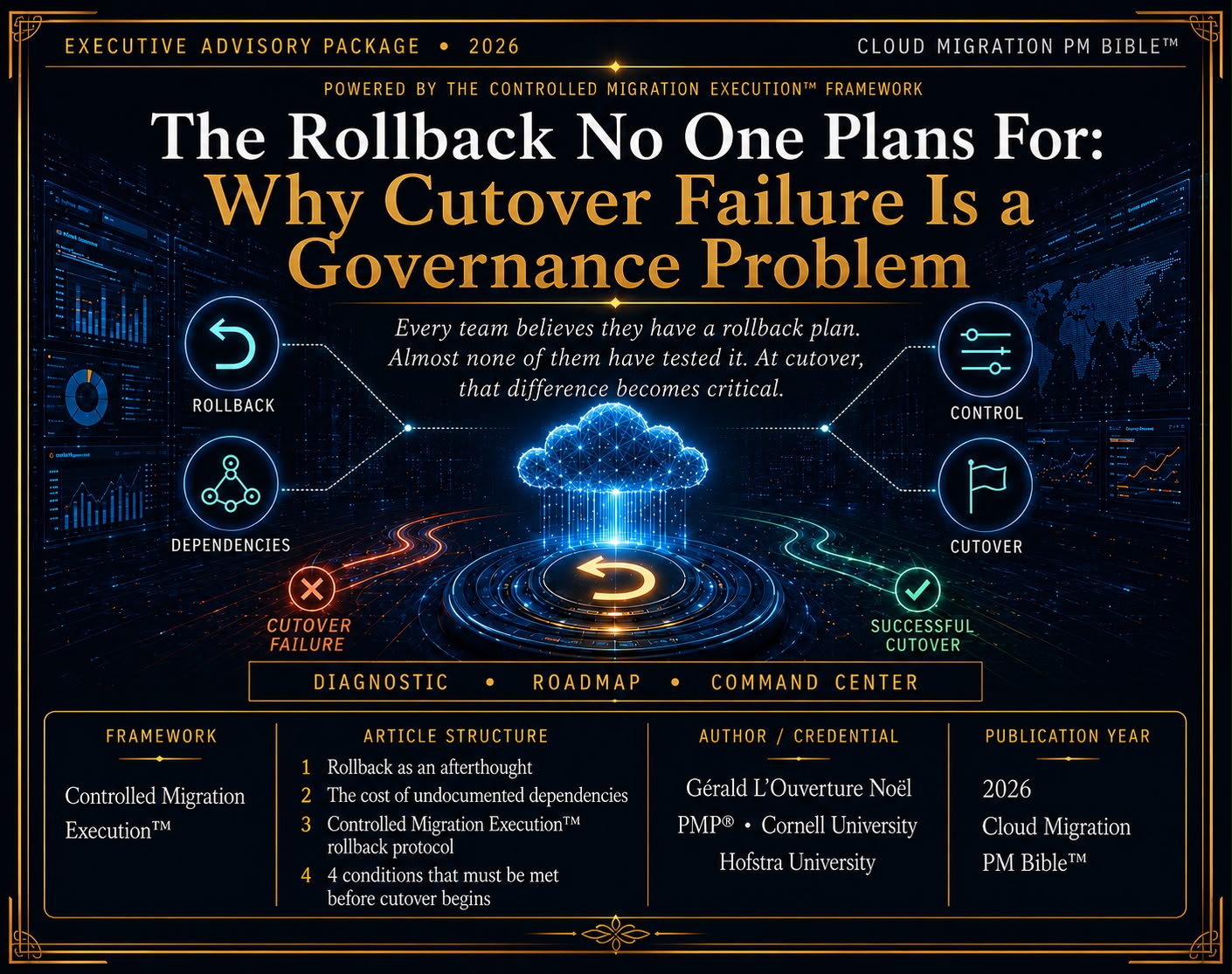
WK:5 | The Rollback No One Plans For: Why Cutover Failure Is a Governance Problem

Every team believes they have a rollback plan. Almost none of them have tested it under pressure. Migration readiness is not proven by documentation—it is proven by validated control. Most organizations confuse artifacts with assurance, but rollback only becomes real when it is tested under time constraints, owned by a named decision authority, triggered by measurable failure conditions, and integrated into cutover execution itself. The Rollback Governance Protocol™ moves rollback from checklist to control, from procedure to enterprise discipline.

Rollback governance is not proven by documented procedures. It is proven by tested execution under pressure. Most organizations believe they are ready because the plan exists. But a team can produce rollback procedures, update trackers, run simulations, and still not be ready. Documentation Proves Effort. Rollback Proves Control.
The Most Critical Misconception in Enterprise Migration Cutover
Why organizations mistake rollback documentation for rollback readiness — and the cost of that mistake.
What You Will Be Able To Do: Validate rollback governance through tested execution rather than documents. Move from procedure-based assurance to control-based verification.
1 — The Problem: Why Rollback Plans Fail Under Pressure
Migration failures during cutover are rarely caused by technical incapability. They are caused by governance failures weeks earlier, when rollback planning was never connected to execution authority.
Research from McKinsey & Company (2023) found that coordination failures and delayed decision-making account for up to 50% of enterprise program cost overruns. Of the primary failure drivers, poor rollback governance and untested decision authority rank among the top causes.
The core problem is not documentation. It is decision readiness.
Organizations often mistake artifacts for assurance. But a rollback plan only becomes valuable when it is connected to real execution and tested under the conditions where it matters most: when failure is happening and the clock is running.
Research from Airbyte (2025) found that teams spend 10 to 20 times more on emergency recovery than on proper rollback planning.
A team can produce rollback plans, define procedures, update trackers, run simulations, and still not be ready.
The document does not reveal control. It only reveals completion.
2 — Why Rollback Governance Is the Real Control Mechanism
Rollback governance was designed to identify the system beneath the surface of failing migrations. Not just the technical reversal. The organizational structure of response.
Originally applied to enterprise migration environments, rollback discipline was built around a core truth: migrations do not fail because technical teams lack capability — they fail because organizations lack governance when pressure arrives.
Controlled Migration Execution™ extends rollback planning from a technical checklist into a formal, repeatable governance model integrated with enterprise execution. It moves rollback thinking from documentation to decision authority, and from procedure to operating control.
The difference is critical. A procedure remains a safeguard. Governance becomes control.
3 — The Rollback Governance Protocol™: Five Conditions Before Cutover

The Rollback Governance Protocol™ turns failure-first thinking into structured execution discipline. It forces rollback to be defined, executable, tested, and owned before migration cutover begins.
CONDITION ONE — DEFINED TRIGGERS
Not vague discomfort. Not emotional pressure. Defined triggers. Performance degradation. Data integrity risk. Authentication failure. Security exposure. Business disruption. Expired cutover window.
CONDITION TWO — DECISION AUTHORITY
A named rollback decision authority must exist before cutover. Not everyone. Not the loudest voice. A person with authority, responsibility, and organizational backing to decide under pressure.
CONDITION THREE — TIME-BOUND EXECUTION
Every rollback has a viability window. There is a point where reversal is safe. A point where reversal becomes risky. If that point is not defined before cutover, the team discovers it during crisis. That is too late.
CONDITION FOUR — TECHNICAL EXECUTABILITY
The reverse path must be designed with the same seriousness as the forward path. Backout procedures. State restoration. Configuration reversion. Traffic redirection. Validation checkpoints.
If rollback is not executable, it does not exist.
CONDITION FIVE — INTEGRATION INTO CUTOVER
Rollback cannot sit in a separate document. It must be integrated into execution. Every cutover must define rollback checkpoints, decision points, and reversal steps aligned to each stage.

4 — Five Governance Checkpoints Leaders Must Validate
Before approving go-live, leaders should not ask, "Are we ready?" That question is too easy to answer with optimism. Leaders should validate these five governance checkpoints:
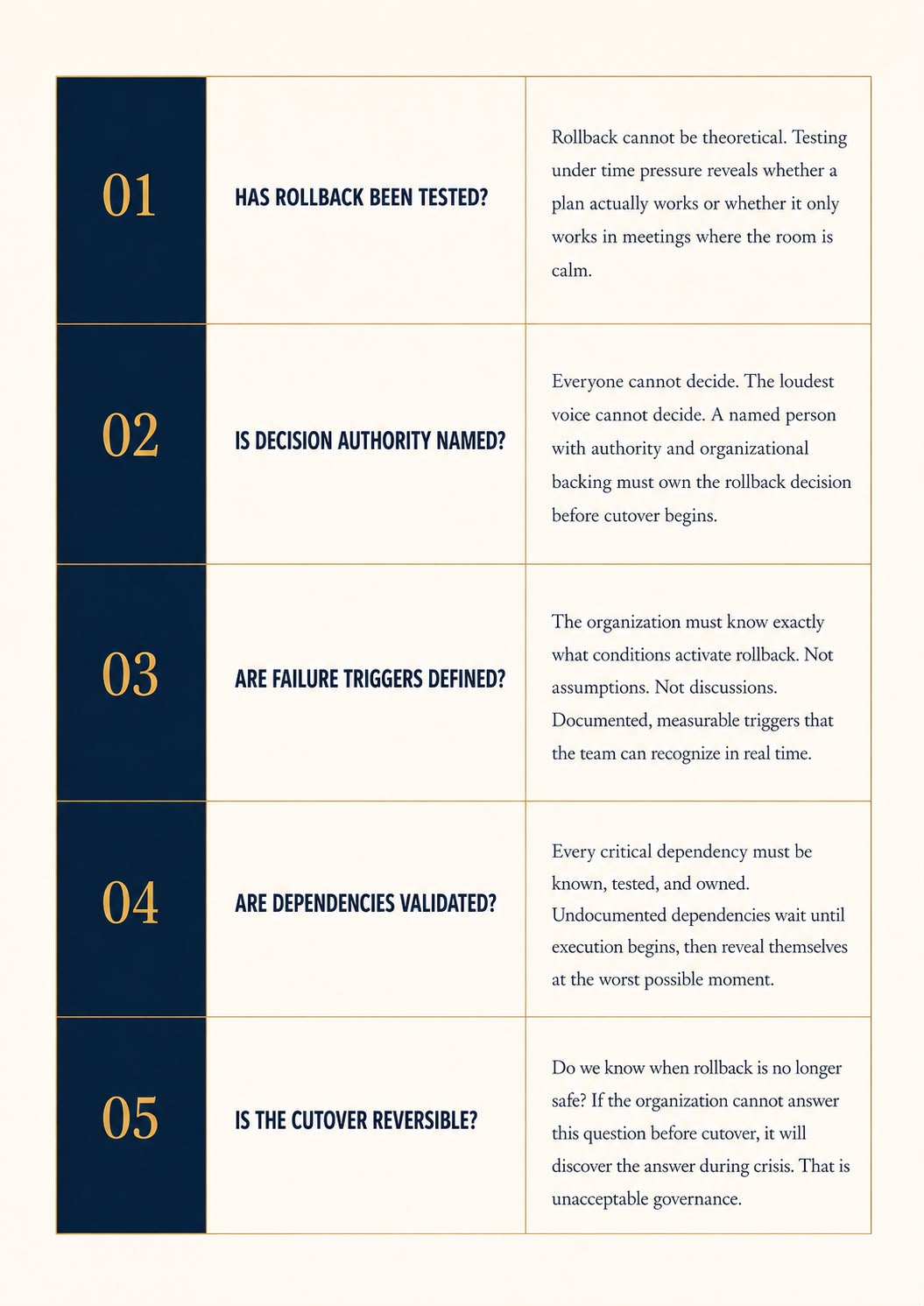
01 | HAS ROLLBACK BEEN TESTED?
Rollback cannot be theoretical. Testing under time pressure reveals whether the plan actually works or whether it only works in meetings where the room is calm.
02 | IS DECISION AUTHORITY NAMED?
Everyone cannot decide. The loudest voice cannot decide. A named person with authority and organizational backing must own the rollback decision before cutover begins.
03 | ARE FAILURE TRIGGERS DEFINED?
The organization must know exactly what conditions activate rollback. Not assumptions. Not discussions. Documented, measurable triggers that the team can recognize in real time.
04 | ARE DEPENDENCIES VALIDATED?
Every critical dependency must be known, tested, and owned. Undocumented dependencies wait until execution begins, then reveal themselves at the worst possible moment.
05 | IS THE CUTOVER REVERSIBLE?
Do we know when rollback is no longer safe? If the organization cannot answer this question before cutover, it will discover the answer during crisis. That is unacceptable governance.
5 — Executive Insight
The PMI Pulse of the Profession research found that organizations with clear governance frameworks and decision readiness structures complete 38% more projects on time and within budget.
That is not a statistic. That is the difference between control and chaos.
Organizations often assume rollback is a binary capability — either you have it or you do not. This is incorrect. Rollback governance is a system of tested controls. It is demonstrable evidence that the organization has defined failure triggers, assigned decision authority, validated dependencies, and integrated rollback into execution before the crisis arrives.
Rollback is not a document. It is tested evidence. It is disciplined governance. It is controlled migration.

6 — Three Questions Every Leader Should Ask
1. Have we tested rollback under time pressure with decision authority present?
If the answer is "the plan looks complete," you have documentation. PRE-MORTEM discipline requires that you have executed reversal under simulated pressure and validated that decision authority can respond.
2. Is rollback decision authority a named person, not a committee?
If decisions will be made by consensus during the crisis, you are not ready. Governance means authority exists before urgency arrives — singular, clear, and accountable.
3. Do we know when rollback becomes unsafe, and have we communicated that threshold?
If the answer is "we'll know it when we see it," you do not have governance. Readiness means the organization has defined the viability window before cutover and every stakeholder understands the point of no return.
7 — The Bottom Line
Most organizations spend millions designing forward migration architecture. Very few spend equal effort designing rollback governance.
Architecture determines what is possible. Rollback governance determines what is permissible.
Because in enterprise transformation, cutover does not fail at the point of execution. It fails at the point of governance — when the organization chose to proceed without tested decision authority, defined triggers, and integrated reversal control.
Don't cutover on the plan. Cutover on the evidence.
Supporting Research & Citations
- McKinsey & Company, Why Do Digital Transformations Fail? (2023) — Coordination failures and delayed decision-making account for up to 50% of cost overruns.
- Airbyte, How to Manage Migration Rollback: Failed Data Migration Recovery Guide (2025) — Teams spend 10 to 20 times more on emergency recovery than on proper rollback planning.
- PMI Pulse of the Profession (2023) — 38% project success improvement with governance and decision readiness structures.
- AWS Migration & Modernization Blog, Migration Rollback Strategies: When Your Migration Doesn't Go as Planned (2026) — Leadership commitment and explicit decision frameworks are essential.
- Gary Klein, Performing a Project Pre-Mortem — Harvard Business Review (2007) — Pre-mortem technique based on prospective hindsight.
- Royal American Group, Decision Authority in Crisis: Who Decides and When (2026) — Decision authority must be defined before crises begin.
- Vedhas, The Hidden Reasons Data Migration Projects Fail—and How To Get It Right (2026) — Governance prevents migrations from becoming cross-departmental blame exercises.
- Cloud Migration PM Bible™ — Gérald L'Ouverture Noël, PMP® (2026)
Framework: Controlled Migration Execution™ | Pillar: Rollback Governance | Week 5 | June 2026
Source: Cloud Migration PM Bible™ · cloudmigrationpmplaybook.com
© 2026 Cloud Migration PM Bible™. All frameworks proprietary and reserved.