WK14: | The PMO That No One Trusts

A PMO loses authority the moment its decisions stop holding. This article traces how governance becomes a reporting office, and how to rebuild mandate, enforcement, and consequence in 90 days.


The PMO That No One Trusts: How Governance Loses Its Authority
Trust is lost when the PMO says one thing but the organization experiences another. Authority is lost when leadership allows the disconnect to continue.
The exact moment authority disappears
The PMO was built to create order. Yet in too many organizations, it becomes the room everyone avoids — not because governance is unnecessary, but because everyone has learned that its decisions do not hold.
A risk turns red. Gate criteria are incomplete. A dependency has no owner. The PMO escalates. Then a sponsor quietly tells the team to proceed. The dashboard is circulated, the minutes are filed, and work continues.
That is the moment governance loses authority. The organization has not governed the problem. It has documented its decision to ignore governance.
Once people recognize that pattern, they adapt: teams soften bad news, sponsors negotiate exceptions outside the forum, and executives ask for green status instead of verified readiness. The PMO keeps reporting, but its reports no longer carry consequence.
In organizations that depend on a PMO, it should function as the execution nucleus — the place where strategy becomes portfolio choices, choices become accountable commitments, and risk becomes decision. It need not make every business decision. It must ensure every critical decision has evidence, an owner, the right authority, a deadline, and a consequence.
The deepest failure: leadership-sponsored inconsistency
PMO authority rarely collapses because of a weak template or an inadequate tool. The deeper cause is leadership-sponsored inconsistency. The PMO says a gate is mandatory, but a leader waives it informally. The PMO says status must reflect evidence, but teams are pressured to remain green. The PMO escalates an unresolved risk, but the sponsor does not respond. The PMO identifies a strategically misaligned project, but funding continues because stopping it is politically difficult.
Every disconnect teaches the organization the same lesson: PMO rules are negotiable, and the most powerful people can bypass them. Authority is delegated by leadership and reinforced through consistent use. When leadership asks the PMO to govern but refuses to honor its gates, decisions, or escalations, it gives the PMO accountability without authority.
Authority = clear mandate + consistent enforcement + visible consequence.
How a PMO becomes untrusted
Reporting replaces decision. Dashboards multiply, meetings fill calendars, and risks are color-coded, but no decision owner is required to act. Information moves; execution does not. Cloud Migration PM Bible states the standard plainly: the goal is not to report activity, it is to enable decisions. [2]
Standards depend on status. Delivery teams are held to process while influential sponsors receive undocumented exceptions. Selective enforcement turns governance from an operating system into a hierarchy of privilege. People stop respecting rules that leadership applies only when convenient.
Escalation becomes circulation. An issue moves from a project meeting to a steering committee to an executive briefing, yet nobody accepts the decision. The PMO becomes a messenger for executive indecision. When the risk finally becomes an incident, the organization blames delivery for a choice leadership declined to make.
Approval is mistaken for alignment. A signature may confirm acknowledgment without creating support. Zscaler: Through The Execution Lens adds one useful warning: real alignment appears in behavior — sharing information, raising risks early, bringing the right people into the work — not merely in formal sign-off. A signed approval with absent behavior is a deferred problem. [3]
Activity is mistaken for control. A busy PMO can still be powerless. Cloud Migration PM Bible warns that meetings, dashboards, tickets, war rooms, and executive briefings may all intensify while execution quality deteriorates. Motion is not governance. Control is demonstrated when validated readiness, risk reduction, and stable outcomes determine what happens next. [2]
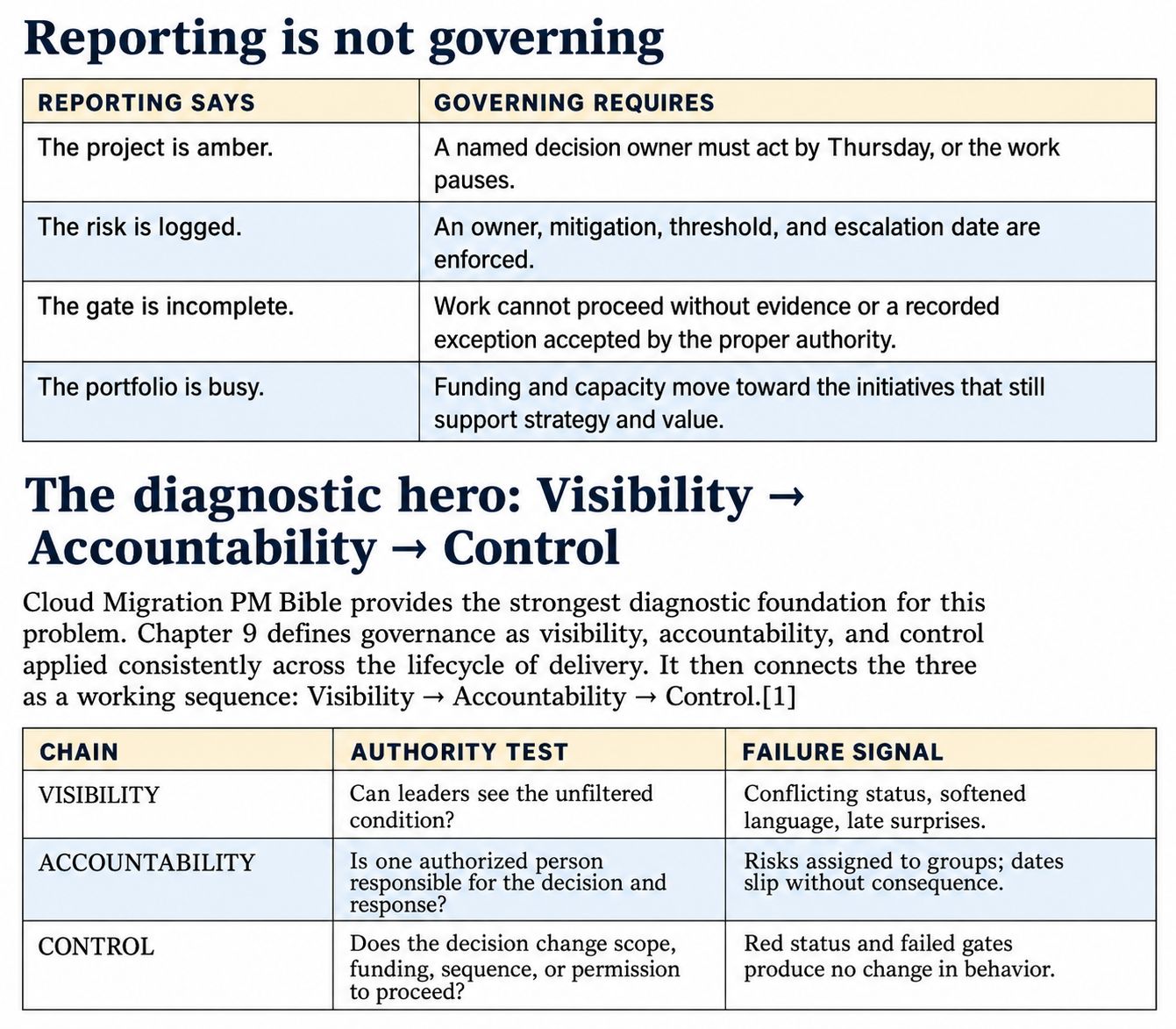
This sequence is the authority test. A PMO may have excellent visibility and still be powerless. If accountability does not follow visibility, it is a reporting office. If control does not follow accountability, it is an administrative office. Trust returns only when all three operate as one chain.
Redesign the PMO as a service, not a compliance checkpoint

This redesign is consistent with PMI's January 2026 research, drawn from more than 1,900 PMO and senior leaders and over 40 in-depth interviews. PMI's finding is that operational excellence is no longer sufficient, and it names three capabilities that raise a PMO's strategic impact: a customer-centric approach, strategic alignment and value realization management, and data and technology integration. [4] PMO-as-a-Service is how those capabilities become operational.
How to rebuild PMO authority in 90 days
Ninety days cannot erase years of mistrust, but it can prove that governance has changed. The recovery should follow the same Visibility → Accountability → Control sequence.
Days 1–30 | Restore visibility
Objective: Create one shared version of delivery reality.
Actions: Interview sponsors, project leaders, delivery teams, and internal customers. Audit every dashboard, gate, and governance forum against the decision it is supposed to support. Eliminate reports that produce no action. Publish a governance compact that states what the PMO owns, what it recommends, who decides, how quickly escalations must be answered, and how exceptions are recorded.
Proof: Baseline stakeholder trust, data reliability, decision latency, overdue escalations, and hidden or conflicting status views.
Days 31–60 | Enforce accountability
Objective: Make every material risk and decision belong to an authorized person.
Actions: Use one decision and escalation log with an owner, due date, evidence, and consequence. Require each executive forum to end with explicit decisions. Make sponsors formally accept residual risk when they choose to proceed. Do not label work green without evidence. Apply the same exception path to every sponsor and project.
Proof: Track response time, overdue decisions, risk-age reduction, ownership gaps, and documented exceptions.
Days 61–90 | Prove control
Objective: Show that governance changes organizational behavior and protects value.
Actions: Hold readiness gates. Pause or redirect work when evidence does not support proceeding. Rebalance resources toward strategic value. Replace activity metrics with outcomes: time to decision, risk closure, benefits at risk, avoided exposure, portfolio alignment, and stakeholder perception of PMO value. Remove PMO activity that does not improve a decision or outcome.
Proof: Demonstrate one visible case where governance prevented exposure, accelerated a decision, stopped low-value work, or restored delivery control.
The final test
The PMO will not regain trust by writing more rules or producing a prettier dashboard. It regains trust when it tells the truth early, leadership acts visibly, exceptions are recorded, and decisions still hold when pressure rises.
The final test is simple: when the PMO says a project is not ready, does the organization pause long enough to decide honestly? If the answer is yes, governance has authority. If the answer is no, the PMO is not governing; it is documenting its own irrelevance.
Governance has authority only when the organization is willing to be governed.
References
[1] Gerald L’Ouverture Noel. Cloud Migration PM Bible™. Chapter 9, “Risk Management and RAID Governance,” pp. 326–365; specifically pp. 327, 334, 339–340, and 343.
[2] Gerald L’Ouverture Noel. Cloud Migration PM Bible™. Chapters 12–14, pp. 407–447; specifically pp. 408, 421, 426–432, 437, 439, and 446–447.
[3] Gerald L’Ouverture Noel. Zscaler: Through The Execution Lens™. Chapter 10, “Political Architecture,” pp. 200–202.
[4] Project Management Institute. Bridging the Gap: Positioning PMOs as Indispensable Partners in Strategy Execution: What must-have capabilities elevate PMO performance? January 2026. https://www.pmi.org/learning/thought-leadership/pmos-as-partners
© 2026 Cloud Migration PM Bible™ — a practice of Eclipse9 Solutions LLC. All rights reserved. www.cloudmigrationpmplaybook.com