WK:2 | The Governance Trap: When Oversight Becomes Overhead

Enterprise programs often die not from lack of process — but from too much of the wrong kind. When governance becomes an obstacle rather than an enabler, delivery slows and teams route around it. The PMO-as-a-Service model shows how to restructure governance without losing delivery momentum.
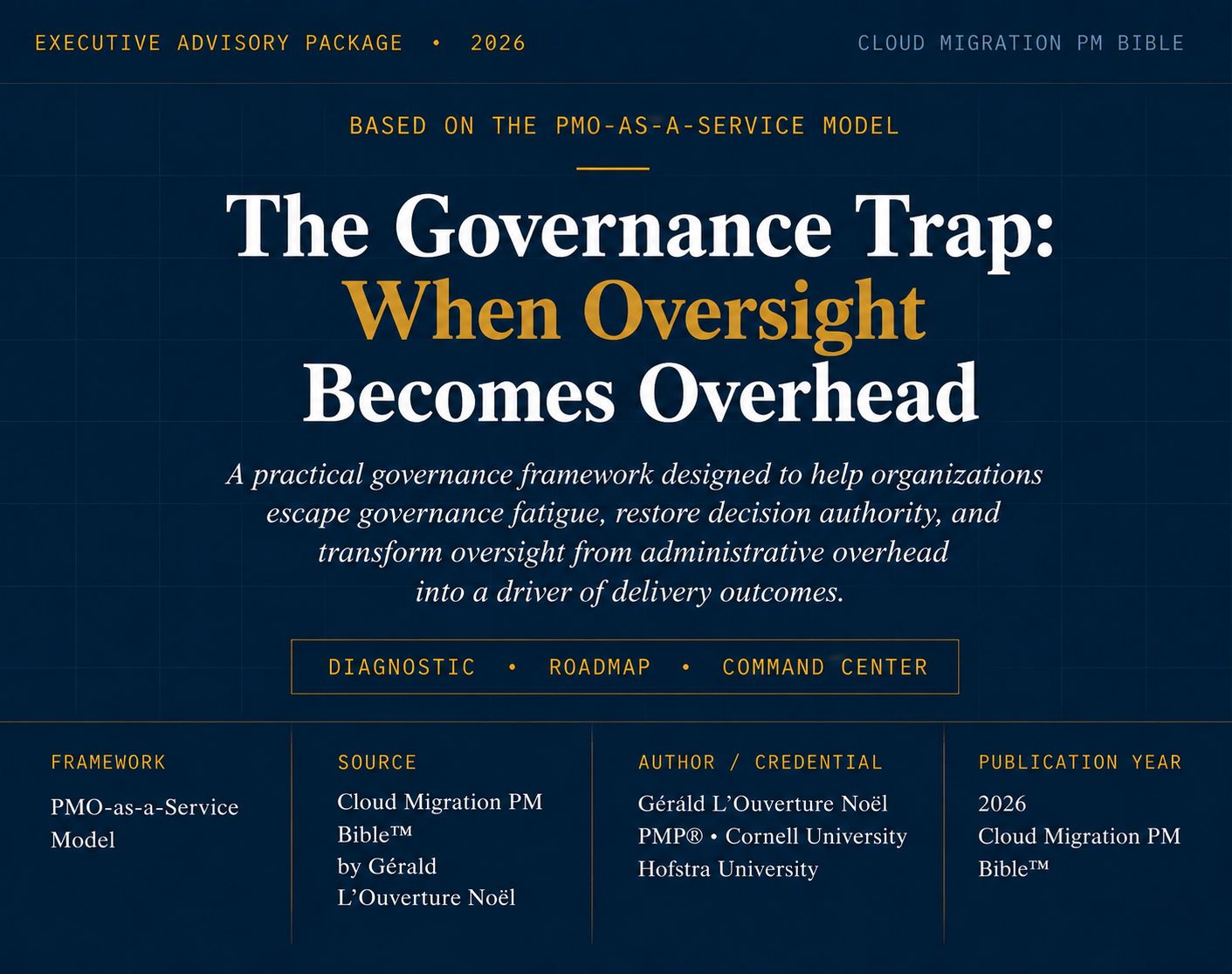

The Governance Trap: When Oversight Becomes Overhead
Enterprise programs often die not from lack of process — but from too much of the wrong kind.
What You Will Be Able To Do: Recognize when governance is creating drag — and restructure it without slowing delivery.
Most organizations build governance to create control. They define committees, establish review cadences, create reporting templates, and layer approval steps into every phase of the program. The intent is clarity. The result is often paralysis.
The governance trap is not a failure of intention. It is a failure of design.
When governance becomes the work instead of the framework for the work, programs stall. Not because the technology is wrong. Not because the team is incompetent. Because the structure built to enable execution is now obstructing it.
1 — Governance Fatigue
Governance fatigue occurs when the volume and frequency of governance activity exceeds its value to the program.
It develops gradually. A status meeting is added. Then a review board. Then a reporting layer above the review board. Each addition is justified individually. Collectively, they consume the energy that should be directed at delivery.
The signs are recognizable:
- Meetings multiply without producing decisions
- Teams prepare for governance reviews instead of executing deliverables
- Status reports grow longer while program progress slows
- Escalation paths become unclear because too many people are involved
At this point, governance is no longer a control mechanism. It has become a full-time job that competes with the program it was designed to govern.
The most dangerous governance trap is mistaking activity for accountability. A team that attends every review meeting is not necessarily a team that is delivering. A program that produces comprehensive status reports is not necessarily a program that is progressing.
Activity and accountability are different things. Governance systems that conflate the two produce organizations that are very busy and very slow.
2 — Reporting Without Authority
Reporting without authority is the most common form of governance dysfunction in enterprise programs.
It occurs when the people responsible for governance are given visibility but not power. They can see what is happening. They cannot change it.
This produces a specific and costly failure mode: governance becomes documentation. Risks are logged. Issues are tracked. Escalations are recorded. None of them are resolved, because the people managing the governance process do not have the authority to resolve them.
The PMO becomes a very sophisticated filing system.
The teams executing the program recognize this quickly. They learn that governance is a reporting obligation, not a decision-making structure. They attend the meetings. They submit the reports. They resolve problems through informal channels because the formal channels do not produce results.
This is not a team failure. It is a governance design failure.
Governance without authority is observation without control. It can tell you what is wrong. It cannot fix it. And in a program under delivery pressure, the inability to act is the same as the inability to govern.
3 — The PMO-as-a-Service Model
The corrective mechanism is the PMO-as-a-Service model.
PMO-as-a-Service reframes the program management function from a compliance and reporting role to a delivery enablement role. It shifts the question the PMO answers from "Are you following the process?" to "What do you need to deliver?"
Five principles that define the PMO-as-a-Service model:
- Service orientation — The PMO exists to serve delivery teams, not to audit them. Every PMO function is evaluated by whether it accelerates or impedes delivery.
- Decision velocity — Governance structures are designed to produce decisions at the speed of execution. Review boards have defined authority and defined timelines. Decisions that cannot be made within the governance structure are escalated with a response SLA.
- Authority alignment — Governance roles carry defined authority, not just accountability. The PMO director has explicit authority to direct resources, resolve cross-team conflicts, and escalate to executive sponsors with binding timelines.
- Minimal viable process — Every process is evaluated for the minimum viable version. If a process can be simplified without losing its control value, it is simplified. Complexity is a liability, not a sign of rigor.
- Delivery transparency — Reporting is designed to inform decision-making, not to demonstrate activity. Status reports answer one question: what decisions are required? Everything else is noise.
PMO-as-a-Service transforms governance from a function that observes delivery into a function that enables it.
4 — Three Signs Your Governance Is Creating Drag
1. Teams route around the governance process
When experienced practitioners stop using the formal governance structure to solve problems and create informal workarounds instead, the governance structure has failed. They are not being difficult. They are being efficient. The structure you built has stopped serving them.
2. Governance meetings produce reports, not decisions
Every governance forum should end with a clear set of decisions made, actions assigned, and owners named. If your governance meetings end with a list of things to discuss in the next meeting, your governance is producing activity, not accountability.
3. The program is slower than the work
When the schedule of governance reviews is longer than the schedule of deliverables, governance has become the program. Teams should spend more time delivering than reporting on delivery. If that ratio has inverted, the governance structure needs to be redesigned.
The Bottom Line
Governance is not the enemy of delivery. Poor governance design is.
The programs that deliver consistently are not the ones with the most governance — they are the ones with the right governance. Governance that gives the people executing the work the structure they need to move fast, the authority to resolve obstacles, and the decision paths to escalate when execution collides with reality.
Governance should enable delivery at the speed of execution — not replace it with the speed of process.
Supporting Research:
- PMI Pulse of the Profession — Organizations with high PMO maturity complete 38% more projects on time and within budget.
- Gartner — Through 2027, 70% of digital transformations will fail due to inadequate governance architecture.
- McKinsey — Poor decision-making and coordination failures account for up to 50% of enterprise program cost overruns.
- Cloud Migration PM Bible™ — Gérald L'Ouverture Noël, PMP® (2026)
Framework: PMO-as-a-Service | Pillar: Cloud Migration | Week 2 | June 2026
Source: Cloud Migration PM Bible™ · cloudmigrationpmplaybook.com
© 2026 Cloud Migration PM Bible™. All frameworks proprietary and reserved.