WK6: | The Migration Leader's Real Job: Execution Over Vision

Every migration leader believes they can carry the room. Few have proven they can hold control once the room stops listening and the system starts talking. Migration leadership is not proven by vision - it is proven by governed execution. Most leaders confuse inspiration with readiness, but execution only becomes real when evidence replaces optimism, decision rights are named before pressure arrives, and rollback is treated as control instead of failure. The Execution Command Center™ moves migration leadership from charisma to control, from destination-selling to command.
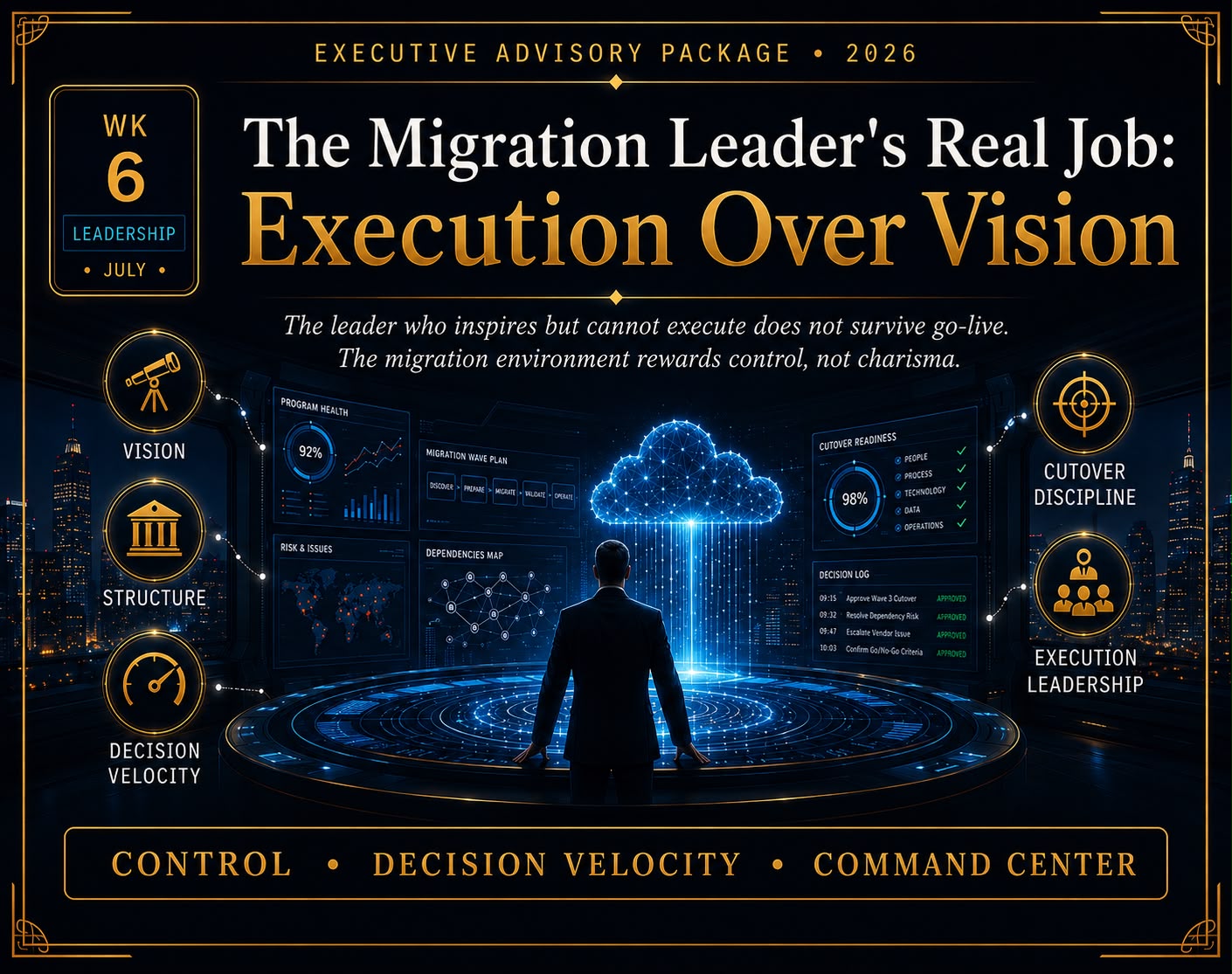

Migration leadership is not proven by inspiring vision. It is proven by execution that holds when the room gets tense. Most leaders believe they are ready because the vision is compelling and the team is aligned. But a leader can articulate a powerful cloud strategy, energize a steering committee, and still lose the migration when go-live exposes what was never operationalized.
Vision Proves Direction. Execution Proves Control.
The Most Critical Misconception in Enterprise Migration Leadership
Why organizations mistake inspirational leadership for execution readiness - and the cost of that mistake.
What You Will Be Able To Do: Evaluate migration leadership through operational control rather than vision alone. Move from charisma-based assurance to command-based verification.
1 — The Problem: Why Vision Collapses When Cutover Demands Control
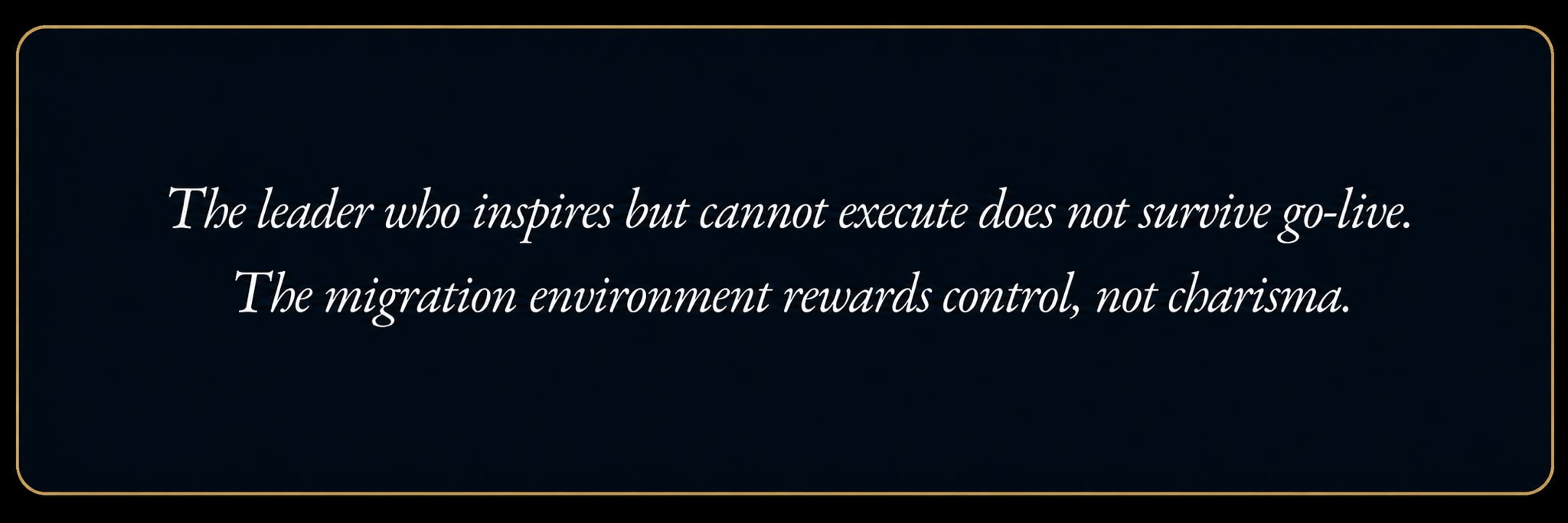
Inspiration creates movement. Control and discipline protect that movement from becoming disorder. The distinction is brutal in migration programs because go-live is not a motivational moment - it is an operational test of every dependency, assumption, ownership model, validation gate, rollback path, and support structure carried into production.
Research into cloud and data migration outcomes puts the stakes in perspective. Gartner research is widely cited as finding that 83% of data and cloud migration projects either fail outright or exceed their planned budget and schedule - a track record that points to governance and control, not technology, as the real differentiator between programs that survive cutover and programs that do not.
A leader can describe a powerful cloud vision and still lose the migration if the system beneath that vision cannot operate under pressure. Vision tells the organization where it wants to go. Execution proves whether it can survive the journey. When vision outruns control, failure begins before the first workload moves: meetings substitute for evidence, dashboards create the appearance of confidence while hidden dependencies stay unchallenged, and cutover plans define the forward path but never the reverse one.
Three failure patterns show up again and again in programs that lead with vision instead of control:
· Activity replaces proof. Status updates and busy dashboards stand in for validated system behavior.
· Escalation stays undefined. Nobody knows who can pause, continue, or roll back until real defects start competing with the cutover clock.
· Rollback is treated as embarrassment. Instead of a designed mechanism for business continuity, reversal becomes something leaders avoid discussing until it is too late.
This is the leadership problem underneath every failed cutover: leaders are celebrated for casting vision, then judged on their ability to preserve control once the migration enters production reality.

2 — Why the Execution Command Center™ Is the Real Control Mechanism
The Execution Command Center™ was not built as another inspirational model. It exists to answer one question: has a migration leader converted vision into an operating system of control? Controlled migration leadership rests on three foundations -leaders must think in systems, design control before movement begins, and prove readiness through evidence rather than confidence. Those foundations are then operationalized through validation, risk management, rollback strategy, monitoring, and stabilization.
That structural discipline is not cosmetic. Deloitte crisis-management research, cited across recent industry analyses, has found that organizations with established crisis processes and dedicated response teams respond effectively to incidents at roughly 2.5 times the rate of organizations that improvise in the moment. A migration Command Center works the same way - it is not a room, it is leadership made visible, testing whether visibility is unified, decisions are coordinated, accountability is immediate, and communication is controlled before cutover, not during it.
If those conditions are not built before cutover, go-live does not create the weakness. It only exposes the weakness that governance failed to correct in advance.

3 — The Controlled Migration Execution™ Framework: Five Stages From Readiness to Stabilization
The framework moves leadership from a readiness conversation to command-center control across five stages:
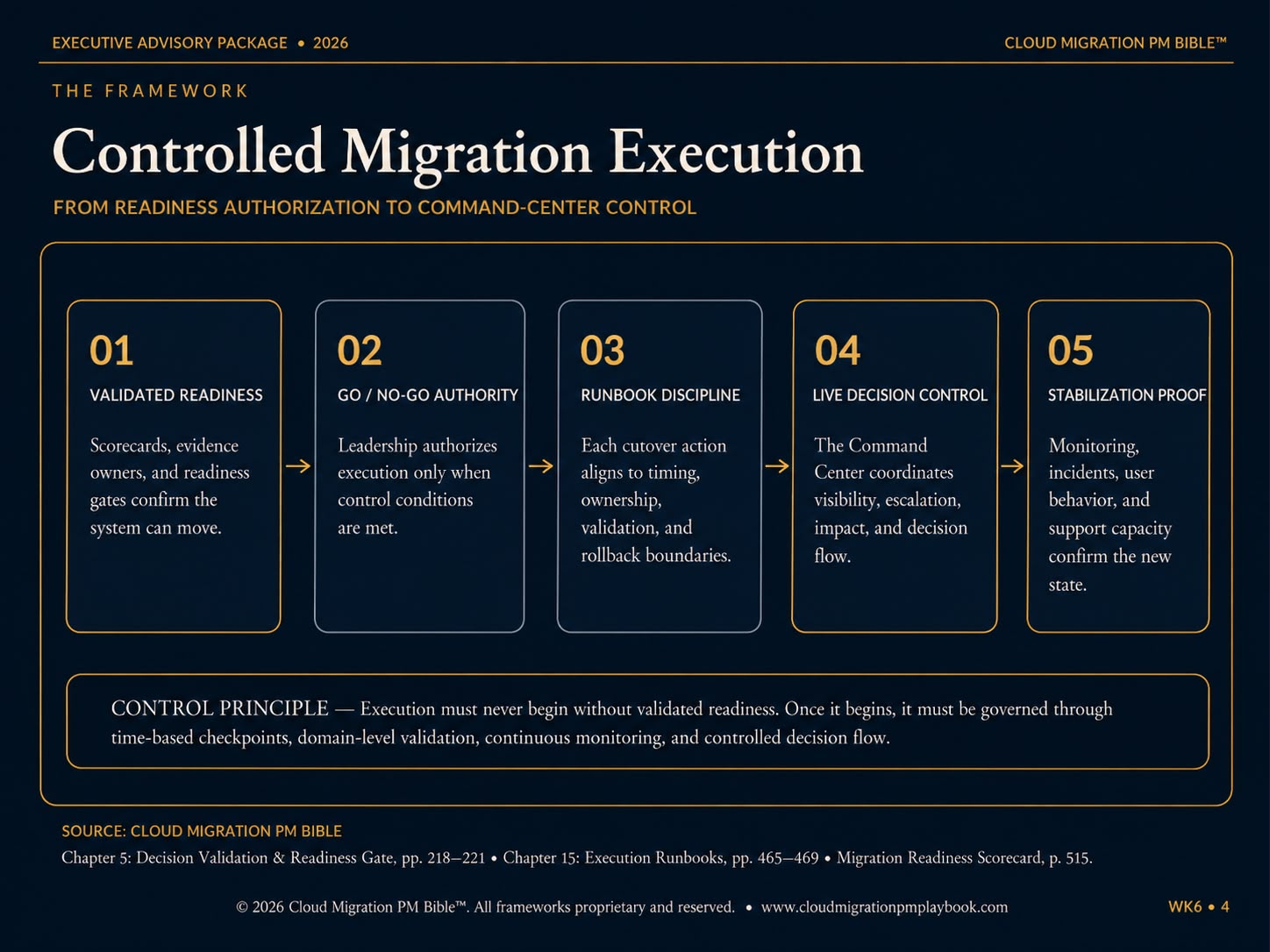
STAGE ONE - VALIDATED READINESS
Scorecards, evidence owners, and readiness gates confirm the system can actually move - not that the team believes it can.
STAGE TWO - GO/NO-GO AUTHORITY
Leadership authorizes execution only when control conditions are met, not when the calendar or executive pressure says it is time.
STAGE THREE - RUNBOOK DISCIPLINE
Every cutover action aligns to timing, ownership, validation, and defined rollback boundaries.
STAGE FOUR - LIVE DECISION CONTROL
The Command Center coordinates visibility, escalation, business impact, and decision flow in real time.
STAGE FIVE - STABILIZATION PROOF
Monitoring, incident volume, user behavior, and support capacity confirm the new state is actually stable - not just live.
Execution must never begin without validated readiness. Once it begins, it must be governed through time-based checkpoints, domain-level validation, continuous monitoring, and controlled decision flow.
4 — Three Leadership Behaviors That Protect Cutover
Systems thinking, wave planning, evidence-based validation, and formal sign-off all matter, but under pressure they compress into three disciplines that actually protect cutover when certainty runs out.
01 | LEAD FROM EVIDENCE, NOT ENERGY
Cutover does not need cheerleading. It needs proof. The leader asks for validation results, defect thresholds, monitoring signals, security confirmation, and business sign-off before allowing movement - a habit that prevents optimism from disguising exposure.
02 | CREATE DECISION VELOCITY WITHOUT CHAOS
Decision velocity is not speed for its own sake. It is the ability to make authorized judgments because escalation paths, thresholds, owners, and impact logic were defined before pressure arrived. This is what prevents paralysis inside the war room.
03 | PROTECT REVERSIBILITY BEFORE PRIDE
The mature leader treats rollback as control, not embarrassment. Barry Staw's foundational research on escalating commitment helps explain why this is so hard: once leaders have invested visible effort in a course of action, they tend to keep funding it even as evidence turns against them. The disciplined leader interrupts that pattern - pausing, reversing, or containing execution before instability cascades, rather than letting pride override the data.
The leader protects cutover by turning ambition into governed execution.
5 — Executive Insight
Leadership research outside the migration world confirms the same pattern. Harvard Business Review has reported that 67% of well-formulated strategies fail because of poor execution, and Robert Kaplan and David Norton's research behind the Balanced Scorecard puts the figure as high as 90% of strategic plans that are never executed successfully. Vision is rarely the scarce resource. Governed execution is.
McKinsey's research into organizational decision-making found something equally instructive: the small group of organizations that make high-quality decisions quickly - rather than trading speed for quality - are roughly twice as likely to report strong financial returns from their most significant decisions. Decision velocity, done with discipline, is not the enemy of decision quality. It is usually a sign of it.
That is not a statistic. That is the difference between a leader who inspires a room and a leader who survives a cutover.
Organizations often assume execution leadership is a personality trait - either a leader has command presence or does not. This is incorrect. Execution leadership is a system of tested controls: evidence gathered before authorization, decision rights named before pressure, dependencies validated before movement, and rollback treated as a governed option rather than a last resort.
6 — Three Questions Every Leader Should Ask
1. HAVE WE VALIDATED DEPENDENCIES ACROSS EVERY DOMAIN, OR ONLY THE ONES THAT WERE EASY TO CHECK?
If the answer is "the plan looks complete," you have a plan, not proof. Readiness requires evidence owners who can show validated results across people, process, technology, and data - not a checklist marked done from memory.
2. IS ROLLBACK EXECUTABLE RIGHT NOW, OR DOES IT JUST EXIST AS A DOCUMENT?
If the reverse path has never been tested with the same seriousness as the forward path, it does not exist as a control - it exists as an intention. Backout procedures, state restoration, and validation checkpoints need to work, not just be written down.
3. DO OUR DECISION THRESHOLDS AND ESCALATION PATHS HOLD WHEN THE ROOM GETS TENSE?
If the honest answer is "we will figure out who decides when we get there," you do not have decision velocity - you have hope. Named authority, defined thresholds, and rehearsed escalation are what let a leader move fast without losing control.
7 — The Bottom Line
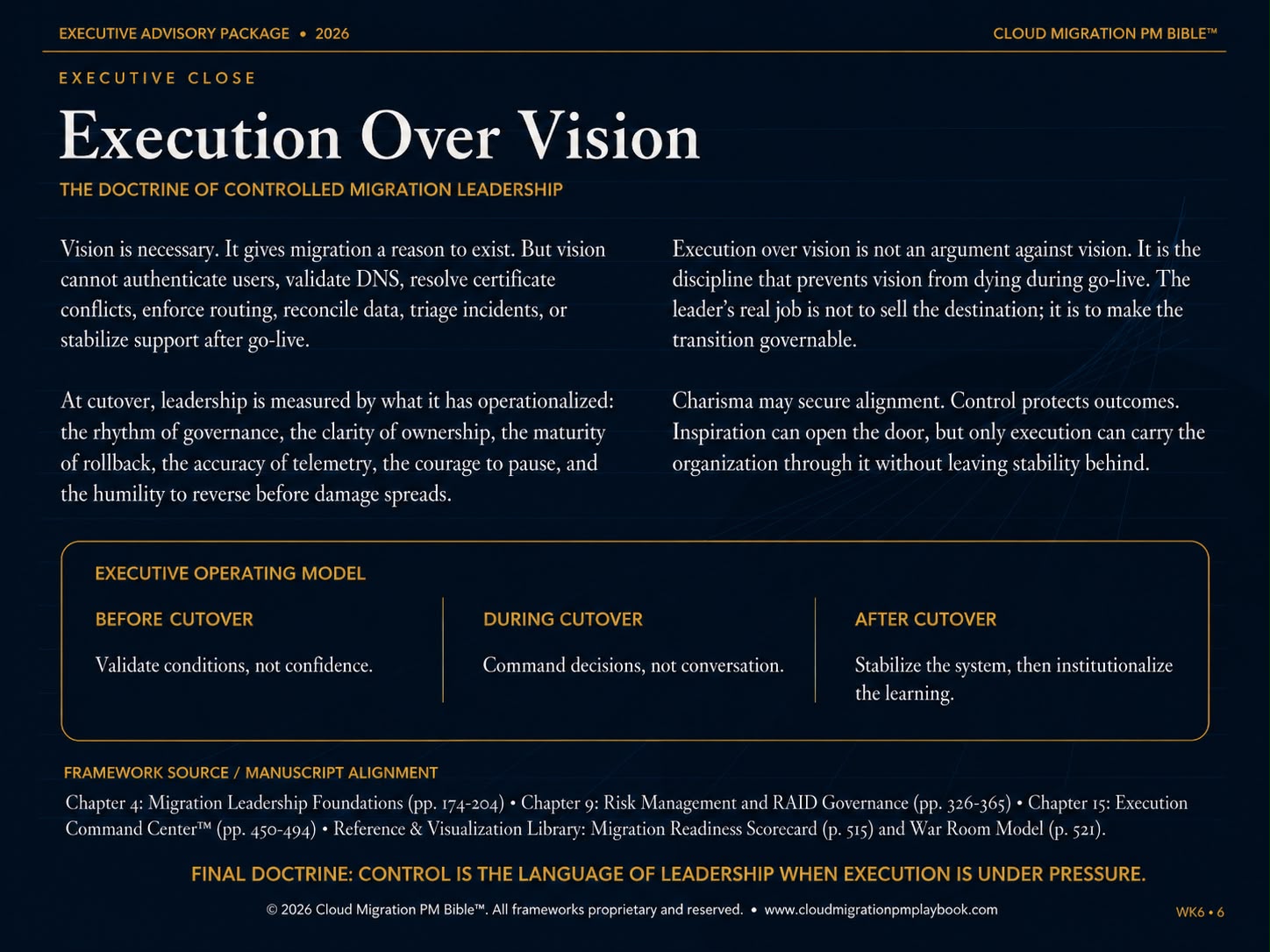
Vision is necessary. It gives a migration a reason to exist. But vision cannot authenticate users, validate DNS, resolve certificate conflicts, enforce routing, reconcile data, triage incidents, or stabilize support after go-live.
At cutover, leadership is measured by what it has operationalized: the rhythm of governance, the clarity of ownership, the maturity of rollback, the accuracy of telemetry, the courage to pause, and the humility to reverse before damage spreads.
Execution over vision is not an argument against vision. It is the discipline that keeps vision alive through go-live. The leader's real job is not to sell the destination - it is to make the transition governable.
Charisma may secure alignment. Control protects outcomes.
Inspiration can open the door. Only execution can carry the organization through it without leaving stability behind.
Supporting Research & Citations
· Gartner research, widely cited across industry migration analyses (2024-2026) - 83% of data and cloud migration projects either fail outright or exceed their planned budget and schedule.
· Deloitte crisis-management research, as reported in industry crisis-communications analysis (2025) - organizations with established crisis processes and dedicated response teams respond effectively to incidents at roughly 2.5 times the rate of those without.
· Harvard Business Review - 67% of well-formulated strategies fail due to poor execution.
· Robert Kaplan and David Norton, The Balanced Scorecard - up to 90% of strategic plans are never executed successfully.
· McKinsey & Company, Decision Making in the Age of Urgency - organizations that pair decision speed with decision quality are roughly twice as likely to report strong financial returns from their most significant decisions.
· Barry M. Staw, "Knee-Deep in the Big Muddy: A Study of Escalating Commitment to a Chosen Course of Action" (1976) -foundational research on why leaders continue funding failing courses of action.
· Cloud Migration PM Bible™ - Gérald L'Ouverture Noël, PMP® (2026).
Framework: Controlled Migration Execution™ | Pillar: Execution Leadership | Week 6 | July 2026
Source: CloudMigration PM Bible™ · cloudmigrationpmplaybook.com
© 2026 Cloud Migration PM Bible™. All frameworks proprietary and reserved.