WK9: | Lift and Shift is a Strategy Just Not the One You Think

Rehost — lift and shift — is a legitimate strategy, not a failure of ambition. It buys speed and removes an immediate constraint. What it does not do is modernize. This article sets out when Rehost is the right call, when it becomes an expensive way to postpone a decision, and how to govern the debt it carries forward: baselines before cutover, evidence-based validation, executable rollback, hypercare monitoring, and named ownership of the next decision. Migration is not proven by movement, but by whether the new state is understood, controlled, and sustainable.


Lift and shift is not wrong. It is simply misunderstood. The organizations that fail with it did not understand what they were moving.
The Weekend Everything Worked
The servers move. The dashboards turn green. The deadline is met.
Then the invoice arrives. Performance problems remain. The same manual runbooks are still executed by the same three people. The fragile dependencies now live at a new address.
Nothing broke. That is exactly the problem.
The migration succeeded technically and failed strategically — because the organization did not transform the workload. It relocated it.
Formally called Rehost, lift and shift creates speed, removes an immediate infrastructure constraint, and establishes a safer position from which to modernize later. It works only when leadership understands exactly what it will accomplish — and what it will leave untouched. (Cloud Migration PM Bible™, Chapter 7, pp. 263–265)
1. What Rehost Actually Changes
Rehost moves an application largely as it exists today, often from an on-premises virtual machine to a cloud-based virtual machine. It changes the hosting environment. It does not change the application.
The move may remove dependence on a physical data center. It does not inherently redesign architecture, simplify integrations, eliminate manual work, improve recovery procedures, or correct inefficient resource use.
Rehost changes where the system runs. Modernization changes how the system works.
The manuscript documents the failure pattern precisely: leadership issues a broad instruction to move everything to the cloud. Because no workload-level strategy is defined, engineering defaults to Rehost. Months later, costs increase instead of decreasing, performance issues emerge, and legacy inefficiencies remain unchanged. (Chapter 7, p. 264)
The cloud did not create those weaknesses. The migration carried them forward.
Strategy, Execution, and Sequence Are Three Different Decisions
The 6R framework defines what happens to a workload. The execution approach — Big Bang, phased, or parallel — defines how that strategy is carried out. Wave planning defines when each workload moves, and in what dependency-aware sequence. Collapse those three questions into one and control is lost before movement begins. (Chapter 7, pp. 266–270)
The relationship runs in one direction: strategy sets the load, execution carries it. A Rehost may tolerate a Big Bang cutover, because the system is not being fundamentally altered. A Refactor typically requires phased execution. A Repurchase to SaaS often requires parallel dual-run. Alignment here is not a preference. It is a control mechanism. (Chapter 7, p. 269)
2. When It Is the Right Call
Rehost is often correct when speed is a genuine business constraint — not a substitute for analysis. The strongest cases:
- A data center lease is ending and workloads must move within a fixed window.
- Infrastructure requires an urgent refresh the current environment cannot support.
- The organization needs temporary stabilization before deeper modernization.
- A compressed timeline makes combining relocation with redesign too risky.
In these situations, Rehost separates two problems that should not be solved simultaneously: the urgent need to move, and the longer-term need to improve. That is a mature decision.
The Trap Inside the Strongest Use Case
Data center exits with hard lease deadlines are also the most common scenario where Rehost gets locked in by deadline pressure — even when Replatform or Refactor is the right long-term answer. The condition that most justifies Rehost is the same condition that most often disguises a default as a decision. (Chapter 7, p. 271)
Three Questions Before Approval
- What immediate constraint does this decision remove?
- What technical and operational debt are we knowingly carrying forward?
- Is Rehost the destination — or a controlled bridge to the next strategy?
If those answers are explicit, owned, and time-bound, lift and shift can be highly effective. If they are not, Rehost is not being selected. It is happening.

3. Rehost Is Not the Same as Low Risk
This is the sentence most programs skip. Moving technical debt without redesign preserves it. Three forms travel with the workload:
- Hidden technical weaknesses — undocumented dependencies, brittle integrations, single points of recovery.
- Manual operational patterns — the runbooks, the workarounds, the person who knows how it really works.
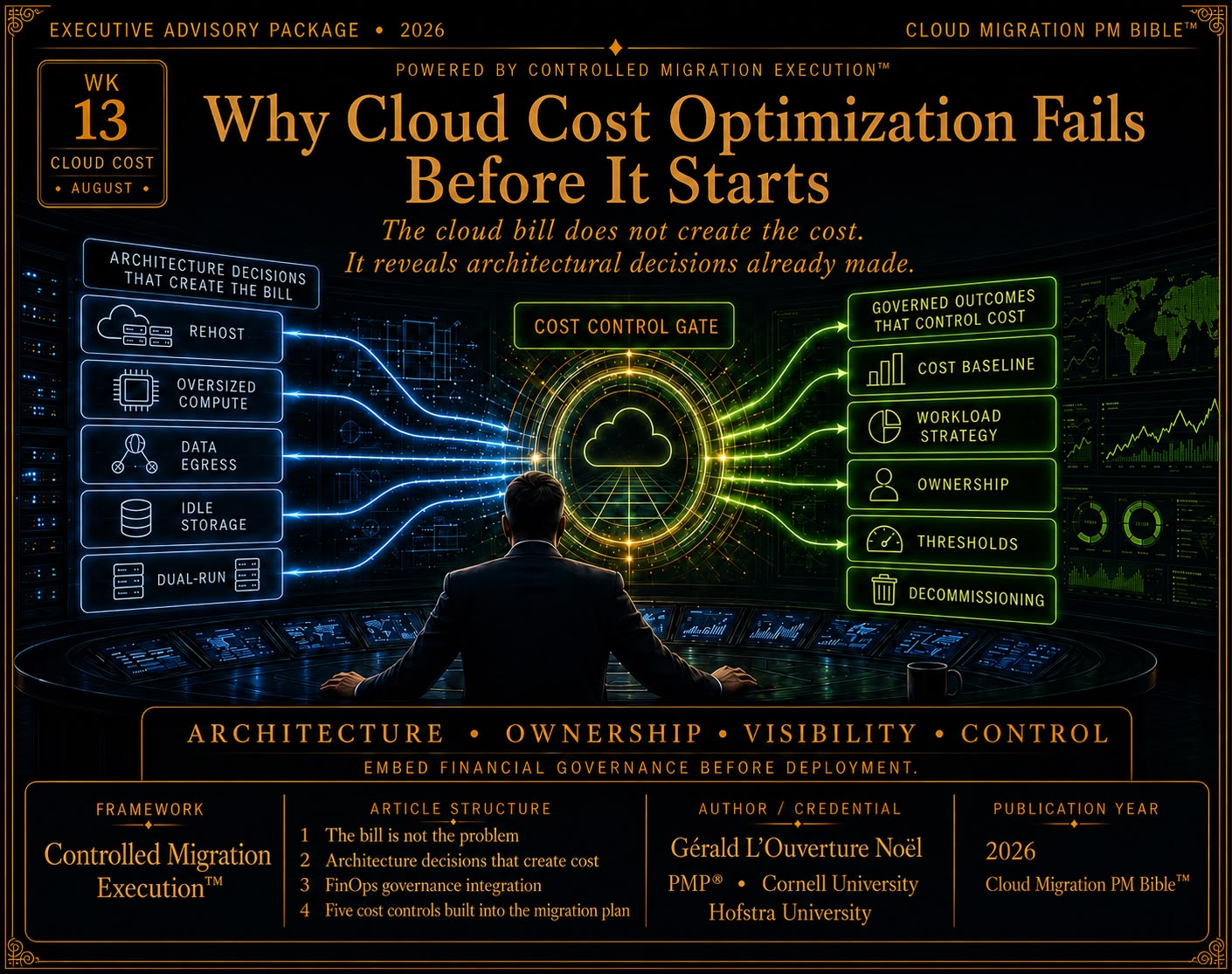
- Inefficient cost structures — capacity sized for a data center refresh cycle, not for elastic consumption. On-premises sizing assumptions become a monthly bill.
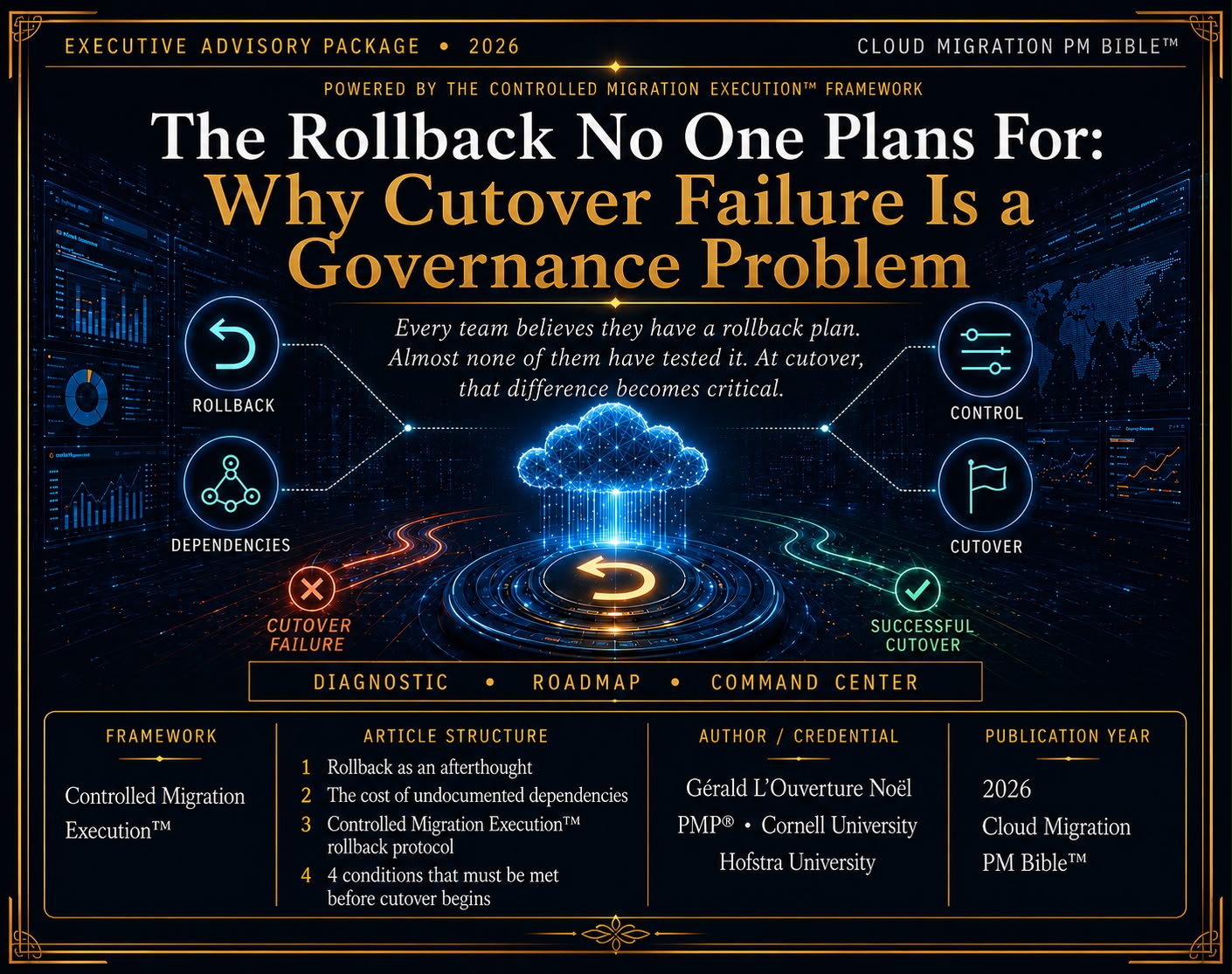
These stay invisible through cutover because the first test is trivial: Did the system come online? Coming online is not operating well. (Chapter 7, pp. 271–272)
Sixty Days Later
Picture the legacy application migrated over a weekend. Authentication works. Users connect. The program reports success.
Sixty days later, the same manual maintenance is running. Performance has not improved. Recovery still depends on a handful of people. Cloud resources reflect old capacity assumptions rather than actual demand.
Rehost did not fail. It delivered exactly what was selected: the existing operating reality, in a new hosting environment. The strategic failure occurred earlier — when leadership expected modernization but authorized relocation.
Debt is not disqualifying. It becomes dangerous when it is unnamed, unowned, and permanent. A mature Rehost decision records the debt being accepted, assigns responsibility, and sets the date of the next decision.

4. Governing the Move
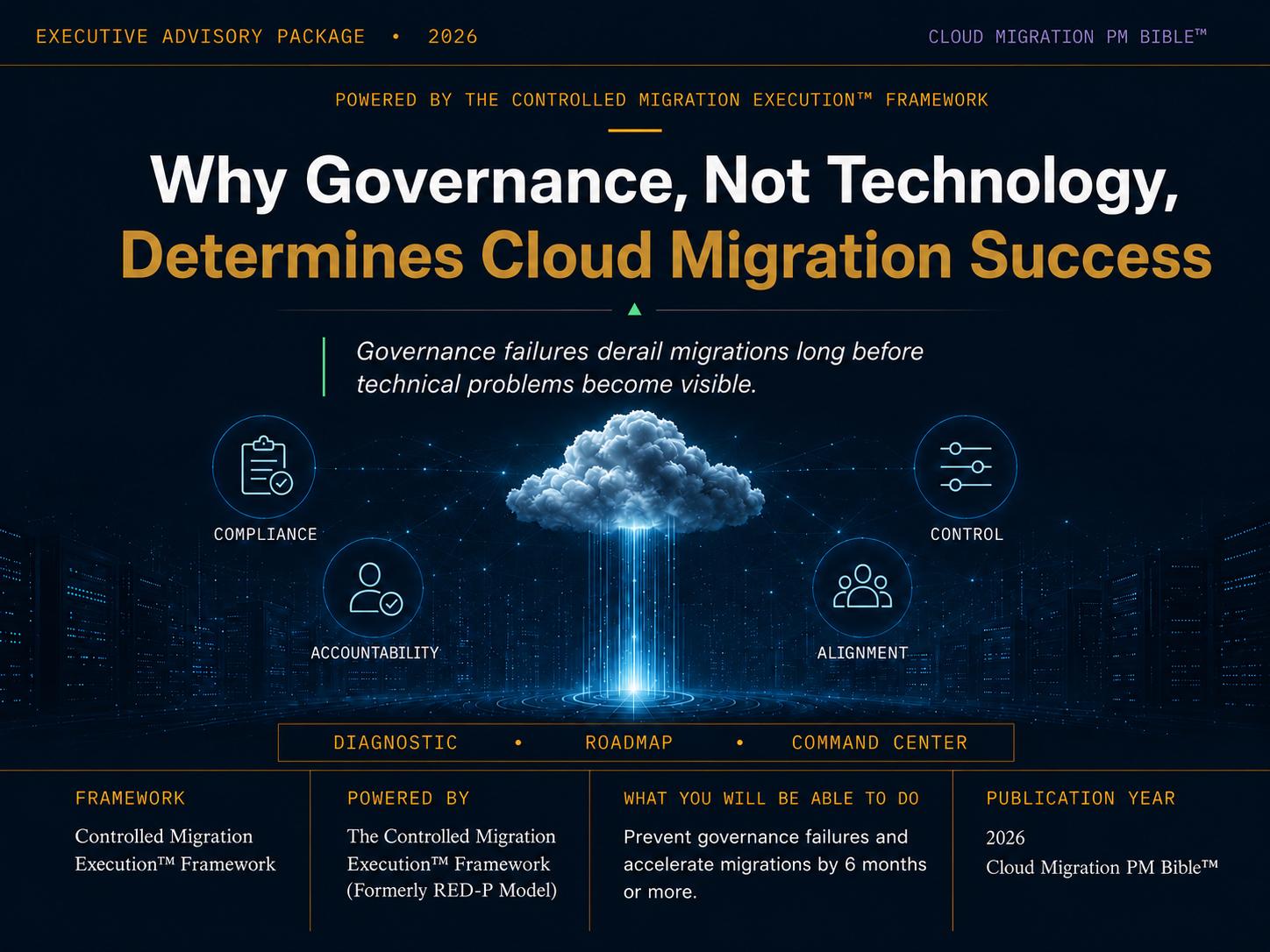
The answer is not to make Rehost more complicated. It is to make the decision and its controls deliberate. Controlled Migration Execution™ rests on three foundations that precede the four operational pillars. (Chapter 4, pp. 180–184)
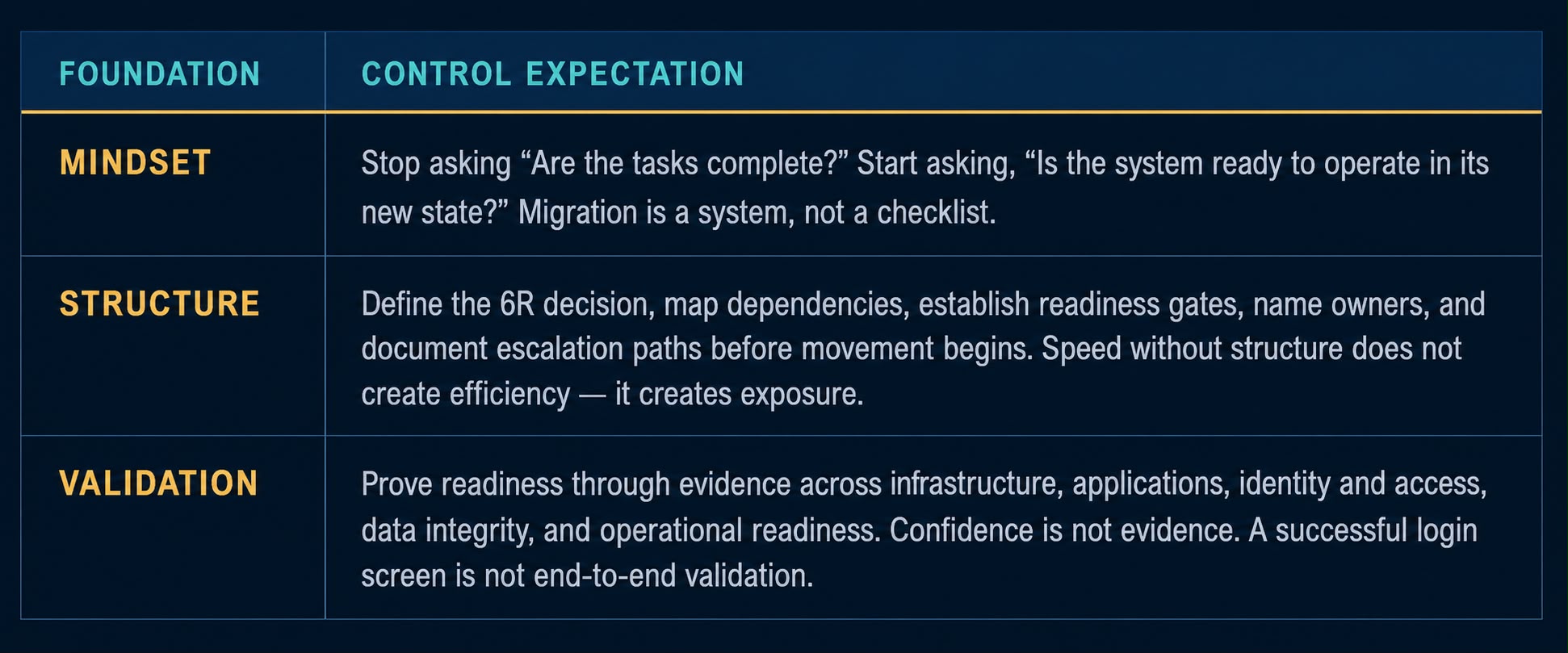
The Rehost Control Checklist
The three foundations become operational through four pillars — validation, risk management, rollback strategy, and monitoring and stabilization. For a lift-and-shift, that means six enforceable controls. (Chapter 4, pp. 189–202)

The objective is not to pretend Rehost produces modernization. It is to use Rehost for what it does well — speed and relocation — while controlling what it does not solve.
The Bottom Line
The wrong question is: Is lift and shift good or bad?
The right questions are: What outcome are we asking it to produce? What debt are we knowingly carrying? Who owns the next decision?
Chosen deliberately, lift and shift is a controlled bridge. It creates speed, removes a constraint, and buys time to modernize responsibly. Chosen by default, it is the old environment with a new address — and a new invoice.

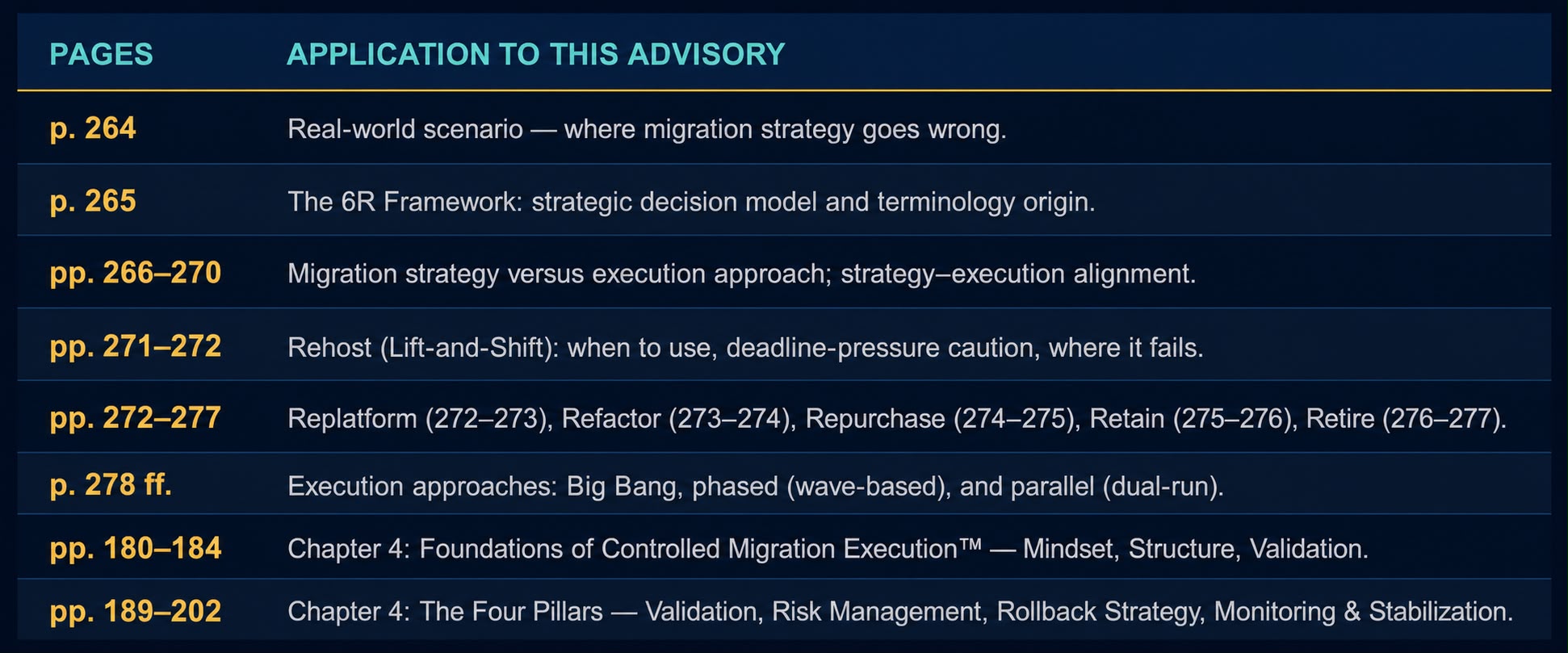
Most Directly Relevant Pages
Primary source: Cloud Migration PM Bible™, Chapter 7: Migration Strategy and the 6R Framework, pp. 262–277. Page references correspond to the manuscript’s printed pagination.
© 2026 Cloud Migration PM Bible™ • All frameworks proprietary and reserved. • www.cloudmigrationpmplaybook.com